On 15 May 2026, Google updated its Search Central docs with a guide on optimizing for generative AI features. The document looks routine. It’s actually a market correction, and most of the industry has missed why.
The line everyone should be reading is buried in the opening:
“From Google Search’s perspective, optimizing for generative AI search is optimizing for the search experience, and thus still SEO.”
That sentence quietly ends an entire consultancy category. Eighteen months of AEO and GEO advice, the llms.txt files, the content chunking, the special markup, the schema gymnastics, has just been told it’s SEO under a new name. That’s the whole story on that side.
The more interesting part is what Google puts on the desk in exchange.
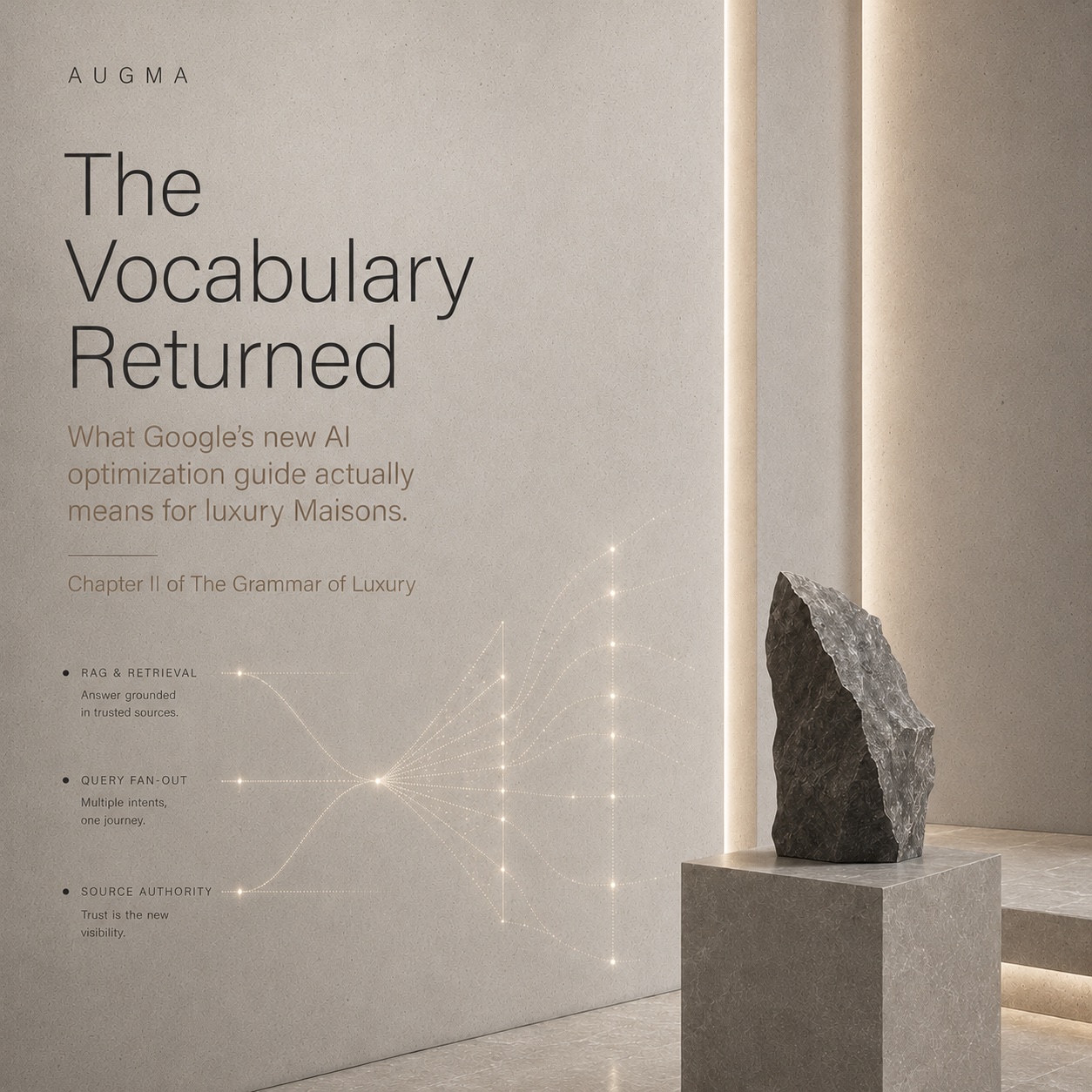
What the CDO actually inherits
Two concepts now sit in the official documentation, and both belong on a Monday morning agenda.
RAG (Retrieval-Augmented Generation). Google has now stated, in writing, that its AI features ground responses in the Search index. When AI Overviews or AI Mode answers a question about a Maison, the model pulls what the index holds, then writes from there. The consequence is mechanical. If the truth a Maison wants told isn’t crawlable, structured, and consistent across its main surfaces, the model fills the gap with whatever else is around. Old press releases. Forum threads. A competitor’s framing. A misattributed Wikipedia line.
Query Fan-Out. Google now spins off a cluster of related queries for every prompt. A single question about a Maison’s fragrance doesn’t get answered with one search. It gets answered from a cluster: comparable houses, ingredient claims, price perception, gifting context, regional availability. The Maison’s narrative gets read across all of those at once, whether the Maison is watching or not.
Both ideas have less to do with how a Maison writes than with whether what’s already written can be found, ranked, and held together coherently by the models. Which is a different kind of work.
Two jobs, not one
This is the line the industry needs to draw clearly in 2026.
There’s the editorial job. Codes, taxonomy, tone of voice, the assertions a Maison wants to make about itself. Content strategists, brand directors, editorial teams. This has been the discipline of luxury communication for a century, and nothing in the new Google guide makes it less necessary.
Then there’s the second job, which Google has now implicitly put on the table: instrumentation. Measuring whether those assertions are flowing through the AI stack the way they’re meant to. Where they break. Where they drift. Where a competitor’s framing is taking their place. Where the grounding sources Google relies on are pointing somewhere other than the Maison itself.
You need both. Editorial without instrumentation produces beautiful work nobody inside the Maison can verify is landing. Instrumentation without editorial is a dashboard watching a void.
Most agencies and consultancies sell the first. Very few sell the second. The CDO chair is where these are supposed to meet.
Where luxury starts ahead, and where it stops
The signals Google now formalizes (first-hand authority, expert perspective, non-commodity content, real narrative authenticity) line up neatly with what serious Maisons already produce. Heritage, savoir-faire, ateliers, archives, primary editorial. The category is unusually well-stocked for the material RAG systems are designed to surface.
Where it stops is on the instrumentation side. A meaningful number of Maisons currently sit in a strange place: remarkable editorial substance, almost no visibility into how that substance is being represented across ChatGPT, Claude, Gemini, Perplexity, and Google AI Overviews. The material exists. Whether it’s flowing, where it fails, and how it compares model to model is not something anyone inside the Maison can actually see.
That’s the work AUGMA does. Not advising on what to write. Reading what the AI is reading, repeating, inventing, and tracing where it actually came from. The Brand Truth Profile, the Hallucination Tracker, the Source Authority Mapping, the Cross-Model Consistency score are instruments on one dashboard, and the point of the dashboard is to make the AI’s version of a Maison something the Maison can actually see and correct.
The window
The next twelve months will decide which Maisons end up quoted, with what attributes, in the way the AI describes the luxury category for the next decade. The editorial work most houses already do is necessary. It’s just no longer enough on its own.
Houses that pair editorial with serious instrumentation in 2026 will get quoted accurately by the models. Houses that treat this as a content strategy problem alone will keep producing excellent work the models paraphrase, confuse, or skip.
Google has handed the industry an unusually clear brief. The advantage is with whoever reads it as two jobs, not one.