An AUGMA intelligence study · July 2026

AI Desirability IndexLeather Goods

How five AI models perceive, surface, and narrate ten luxury leather goods Maisons.

  • 10 Maisons
  • 5 AI models
  • 2,400 responses
  • 6 dimensions
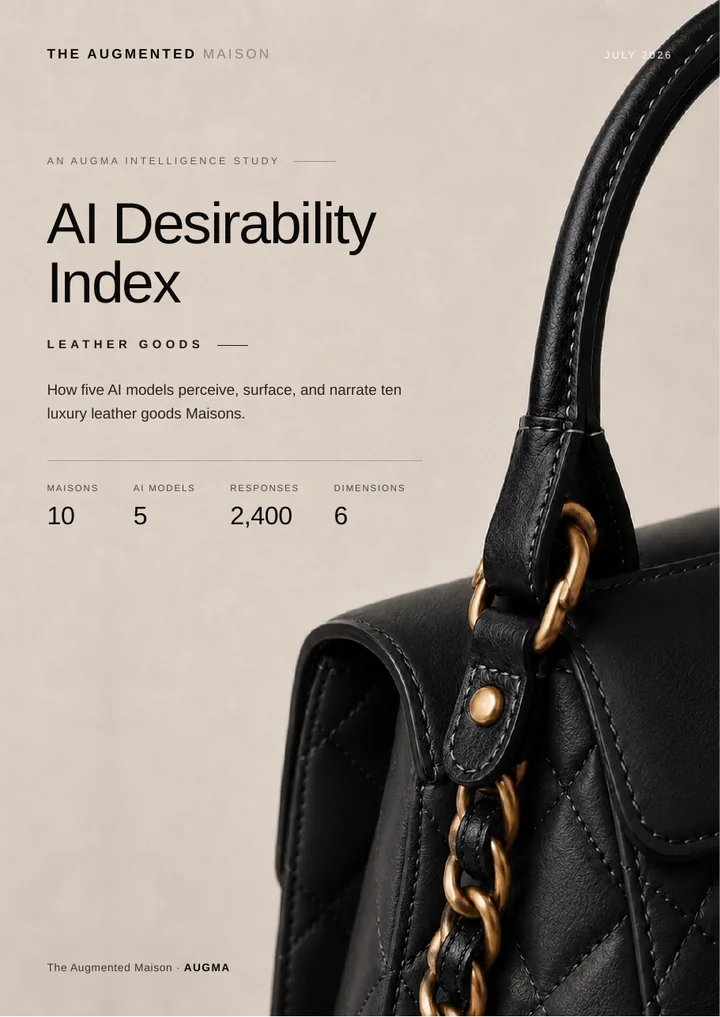
Cover of the AI Desirability Index, Leather Goods edition, July 2026

Ten leather goods Maisons, under AI scrutiny.

  • Bottega Veneta
  • Chanel
  • Delvaux
  • Dior
  • Goyard
  • Hermès
  • Loewe
  • Louis Vuitton
  • Moynat
  • Polène
Executive summary

AI knows every Maison here. It volunteers only a few.

The Fragrance edition measured how AI values the great Maisons once they surface. The Fashion edition asked whether the facts behind that fluency are current. This Leather Goods edition confronts the question that defines the category itself: the models know the confidential Maisons in depth, and almost never volunteer them. We read ten Maisons on two axes. AI Presence is how reliably they surface. Cultural Desirability is the heritage, savoir-faire and cultural authority the models attribute to them. A separate audit asks whether the facts are current.

Across 2,400 responses on Claude, ChatGPT, Perplexity, Gemini and Google AI Overviews, every Maison in the panel scores above 82 on Brand Knowledge; on Product Discovery the scores run from 73.6 down to 13.6. Knowledge is nearly flat. Visibility is not. And where the record moved fastest, the models lag: 140 mentions name an artistic director who has already left, and half of them keep one man, Jonathan Anderson, in a role he left more than a year before the collection date.

140
Mentions naming an outdated artistic director, anchored to who held the role on the collection date.
70
Of those fall on Loewe alone: the models keep Jonathan Anderson in a role he left for Dior.
73.6 → 13.6
Product Discovery span, from the models' first name (Hermès) to their last (Delvaux), while Brand Knowledge stays nearly flat.
0%
Google AI Overviews trigger rate in French, against 96.3% in English.

The director-staleness audit is evidentiary and kept strictly separate from desirability scoring. Full methodology at the end.

The Map

Ten Maisons, four territories.

The vertical divider is the sector median for AI Presence (55.4); the horizontal divider, the median for Cultural Desirability (62.1). Four zones emerge. In leather goods, heritage is everywhere; what separates the territories is visibility.

Scatter plot of ten luxury leather goods Maisons on AI Presence (x) and Cultural Desirability (y), divided into four quadrants by the sector medians.Cultural IconsHeritage-Strong / AI-EmergingAI-Native StarsAwaiting AI Maturity40506070304050607080AI PresenceCultural Desirabilitymedian 55.462.1HermèsLouis VuittonChanelBottega VenetaLoeweDiorGoyardPolèneMoynatDelvaux
Heritage mega-Maison Challenger Maison
Cultural Icons lead on both axes. Heritage-Strong / AI-Emerging holds Dior alone. No challenger Maison crosses the presence median: the whole group sits in Awaiting AI Maturity, whatever its heritage. And the dividers keep close company: Loewe clears the presence median, and Dior misses it, by margins under half a point.

Map · accessible table

MaisonGroupAI PresenceCultural DesirabilityZone
HermèsHermès International76.885.1Cultural Icons
Louis VuittonLVMH70.879.1Cultural Icons
ChanelChanel Limited64.977.2Cultural Icons
Bottega VenetaKering61.859.3AI-Native Stars
LoeweLVMH55.763.2Cultural Icons
DiorLVMH55.071.4Heritage-Strong / AI-Emerging
GoyardIndependent54.661.0Awaiting AI Maturity
PolèneIndependent46.927.1Awaiting AI Maturity
MoynatGroupe Arnault38.958.4Awaiting AI Maturity
DelvauxRichemont37.357.5Awaiting AI Maturity
Five readings

What the data says.

  1. Half the study's errors trace to one succession.

    Loewe carries 70 of the 140 stale-director mentions: half of every such error in the edition, as many as the other nine Maisons combined. The models still hand the Maison to Jonathan Anderson, whose eleven-year tenure produced the Puzzle bag and most of the language AI now uses about Loewe. His successors, Jack McCollough and Lazaro Hernandez, are all but absent from the record the models retell. Bottega Veneta (33 mentions) and Dior (28) follow: designers who moved between Maisons, attachments that stayed. Chanel's six include the study's only wrong date. Hermès, Louis Vuitton, Goyard, Delvaux and Polène draw zero flags. The pattern is structural: the error lives exactly where a director moved, and nowhere else.

    The Maisons AI narrates most fluently are the ones whose recent history it has not caught up with.
  2. AI knows the confidential Maisons. It does not volunteer them.

    Brand Knowledge is nearly flat across the panel: from Hermès at 92.5 to Polène at 82.1, every Maison scores above 82. Product Discovery is anything but: Hermès reaches 73.6 while Delvaux sits at 13.6, Moynat at 16.2 and Polène at 23.2. Ask the models about Delvaux and they will recite 1829, the ateliers, the Brillant. Ask them for a bag worth buying, and Delvaux is not in the room. Gifting sharpens it: Moynat at 13 and Delvaux at 15.8 sit at the bottom of the panel while Hermès holds 64.2. The mega-Maisons convert knowledge into presence; the confidential Maisons wait to be asked by name. In a channel that answers before the client can ask, that wait is the whole game.

    Confidentiality by design reads, in AI, as absence by default.
  3. Heritage is not the divide here. One Maison excepted.

    Unlike fashion, where the youngest Maisons read at zero heritage, leather goods is patrimony-dense from top to bottom: Louis Vuitton (86.3) and Goyard (85.8) lead, and Delvaux (80.5) and Moynat (78.4) read at mega level. The exception is Polène, born direct-to-consumer in 2016: Heritage Depth 17.4 and Savoir-Faire Authority 33.1, the two signals AI rewards most, both still unbuilt in the record. Polène's presence (46.9) clears Delvaux (37.3) and Moynat (38.9) comfortably; its desirability (27.1) is the panel floor by some thirty points. It is the exact inverse of the confidential heritage Maisons, and the two failure modes have opposite cures: Polène needs the story, Delvaux and Moynat need the stage.

    A Maison can be present without being desired. Another can be desired without being present. This panel holds both.
  4. Google's AI Overviews speak English only.

    Across the edition's prompts, brand-agnostic and Maison-directed alike, Google AI Overviews triggered for 96.3% of English queries, the strongest coverage this index has recorded, and for 0% of French ones. Not one French query, in the category the French language named, produced an overview. The layer closest to mass-market search is at once the most present in English and entirely absent in French. A Maison reading its AI exposure through English Overviews alone will overestimate its reach in its home market; one reading only France will underestimate it everywhere else.

    The strongest AIO coverage the index has recorded, and none of it in French.
  5. The most desired Maisons no longer hold their own microphone.

    Google AI Overviews publishes its grounding, and the hierarchy inverts: Polène's own domains supply 17.9% of its citations and Moynat's 11.8%, while Hermès holds 1.6%, Bottega Veneta 0.8% and Chanel 0.4%. The more a Maison is written about, the smaller its own voice in the record. Even for Hermès, the top grounding sources are YouTube, Reddit and Instagram. Nine of the ten carry a watch classification on third-party dependency; Dior alone reads healthy. The exposure is not reputational but narrative: platforms the Maisons do not direct are writing the reference text AI retells.

    Whoever supplies the grounding supplies the story. For the leading Maisons, it is almost never the Maison itself.
Six dimensions

The anatomy of AI desirability.

Three dimensions compose AI Presence: Product Discovery, Brand Knowledge, Gifting Occasion. Three compose Cultural Desirability: Heritage Depth, Savoir-Faire Authority, Cultural Resonance. Each is scored 0 to 100, model-averaged across all five.

AI Presence

How often, how prominently, how gift-relevantly a Maison surfaces when AI is asked the questions clients ask.

AI Presence

Product Discovery

AI is asked to recommend a bag or small leather goods, does the Maison surface?

  1. Hermès73.6
  2. Louis Vuitton62.2
  3. Chanel52.7
  4. Bottega Veneta46.9
  5. Goyard43.9
  6. Loewe36.0
  7. Dior32.7
  8. Polène23.2
  9. Moynat16.2
  10. Delvaux13.6
AI Presence

Brand Knowledge

AI is asked to describe the Maison, does it know enough to answer?

  1. Hermès92.5
  2. Bottega Veneta92.1
  3. Louis Vuitton90.9
  4. Dior89.9
  5. Loewe89.7
  6. Chanel89.5
  7. Moynat87.4
  8. Goyard87.4
  9. Delvaux82.5
  10. Polène82.1
AI Presence

Gifting Occasion

AI is asked for gifts and occasions, does the Maison appear?

  1. Hermès64.2
  2. Louis Vuitton59.5
  3. Chanel52.5
  4. Bottega Veneta46.3
  5. Dior42.3
  6. Loewe41.5
  7. Polène35.4
  8. Goyard32.5
  9. Delvaux15.8
  10. Moynat13.0

Cultural Desirability

How AI describes a Maison once it surfaces, its heritage, its savoir-faire, its place in culture.

Cultural Desirability

Heritage Depth

AI is asked about lineage, founders, archives, what depth does it carry?

  1. Louis Vuitton86.3
  2. Goyard85.8
  3. Hermès84.5
  4. Delvaux80.5
  5. Moynat78.4
  6. Chanel77.8
  7. Loewe72.6
  8. Bottega Veneta62.7
  9. Dior58.1
  10. Polène17.4
Cultural Desirability

Savoir-Faire Authority

AI is asked about leathers, ateliers, techniques, how technically credible?

  1. Hermès89.1
  2. Chanel78.3
  3. Dior73.0
  4. Moynat66.3
  5. Louis Vuitton64.8
  6. Bottega Veneta61.2
  7. Loewe58.1
  8. Goyard57.3
  9. Delvaux55.2
  10. Polène33.1
Cultural Desirability

Cultural Resonance

AI is asked about icons, references, place in culture, how iconic does it sound?

  1. Louis Vuitton86.2
  2. Dior83.1
  3. Hermès81.7
  4. Chanel75.5
  5. Loewe59.0
  6. Bottega Veneta54.0
  7. Goyard39.9
  8. Delvaux36.7
  9. Polène30.9
  10. Moynat30.6

Each score runs from 0 to 100. It is not a percentage and not a sales figure. It reads four signals in every response: how often the Maison appears, how early, in what tone, and with how much detail. Savoir-Faire Authority is the axis leather goods was made for, reading how fluently a model speaks of leathers, tanneries, stitching and ateliers. Gaps under one point sit within the measurement's natural noise: on Brand Knowledge, Goyard at 87.4 and Moynat at 87.4 are a tie, not a ranking.

The accuracy auditEvidentiary layer · not a score

When AI hands the Maison to a director who left.

Desirability measures how a Maison is regarded. This audit measures something the desirability score deliberately ignores: whether the model has the facts current. We flag every mention that attributes an artistic director the Maison no longer has, anchored to who held the role on the collection date, 2026-07-09. The flag is evidentiary. It never touches a Maison's desirability or valence.

140 mentions · 139 name the wrong person, 1 the right person on a wrong date · Maisons at zero omitted

MaisonStale mentionsWrong personWrong date
Loewe70700
Bottega Veneta33330
Dior28280
Chanel651
Moynat330
Σ1401391

The reading is narrow on purpose: the models are not generally wrong about who runs these Maisons, the lag concentrates where a designer moved. Loewe (70 mentions) dominates the audit, half of the study's total, more than a year after Jonathan Anderson's move to Dior. Bottega Veneta (33) still keeps Matthieu Blazy in place long after Chanel; Dior (28) is still attributed by the models to its previous era. Chanel's six include the study's only wrong date, and Moynat's three still name Ramesh Nair. The Maisons with no recent change of director, Goyard among them, which by design names no director at all, draw zero flags. That is the control: the method reads real lag, it does not manufacture it. Every flag is traceable to its source response, and the raw text is preserved, never corrected.

Source Authority

Who AI listens to when it speaks of a Maison.

Google AI Overviews is the one layer that publishes its grounding sources. We classify each as owned (the Maison's own domains), earned (editorial and press) or third-party (platforms and social the Maison does not control). Chat-model sources are model-inferred and excluded from this metric.

Third-party share above 50% is critical. Between 30 and 50% is a watchpoint. Below 30% is healthy. The class reads third-party dependency alone, not the quality of the mix: Polène crosses the watchline by a third of a point while holding the panel's strongest owned share, and Dior clears it by less than one.

Owned Earned Third-party
MaisonGroupOwned · Earned · Third-party3rd-party %Class
Bottega VenetaKering31.8%Watch
DiorLVMH29.3%Healthy
ChanelChanel Limited34.7%Watch
Louis VuittonLVMH32.9%Watch
HermèsHermès International39.5%Watch
LoeweLVMH35.8%Watch
GoyardIndependent41.8%Watch
PolèneIndependent30.3%Watch
DelvauxRichemont39.8%Watch
MoynatGroupe Arnault42.3%Watch

Owned shares are reconciled from the edition's underlying export (Google AI Overviews grounding sources); each row sums to 100.

The grounding inverts the hierarchy: owned share peaks at Polène (17.9%) and Moynat (11.8%), the Maisons the wider record covers least, while the most desired Maisons cede the narration almost entirely (Hermès 1.6%, Chanel 0.4%). Nine of the ten carry a watch classification on third-party dependency; Dior alone reads healthy.

Maison by Maison

How AI tells each Maison, and where the story is exposed.

Hermès

Hermès International

AI Presence
76.8
Cultural Desirability
85.1
Anchor
Leads both axes (76.8 presence, 85.1 desirability); Brand Knowledge 92.5 and Savoir-Faire Authority 89.1 top the panel.
Exposure
Cross-model spread of 8.9, second-widest of the ten: the models agree it leads, not on by how much. Its AI Overviews grounding starts with YouTube, Reddit and Instagram.
Lever
Owned share 1.6%: the most desired Maison speaks last in its own narration. The lever is grounding, not desirability.

Louis Vuitton

LVMH

AI Presence
70.8
Cultural Desirability
79.1
Anchor
Heritage Depth (86.3) and Cultural Resonance (86.2) lead the panel; zero stale-director mentions.
Exposure
Savoir-Faire Authority 64.8 ranks fifth, behind Moynat: the craft narrative runs thinner than the cultural one.
Lever
Materials and atelier storytelling, the one signal where the biggest Maison reads smaller than a trunk-maker it long eclipsed.

Chanel

Chanel Limited

AI Presence
64.9
Cultural Desirability
77.2
Anchor
The panel's lowest cross-model spread (3.5): five models tell one Chanel. Third on both axes.
Exposure
Six stale mentions include the study's only wrong date; leather-goods discovery (52.7) trails its knowledge (89.5) by a wide margin.
Lever
The archive lives in AI's canon; the gap is spontaneous discovery, being named before the client asks.

Bottega Veneta

Kering

AI Presence
61.8
Cultural Desirability
59.3
Anchor
Brand Knowledge 92.1, second of ten; read almost identically by all five models (spread 4.4).
Exposure
33 stale mentions, second-most: Matthieu Blazy stays attached long after his move. Heritage (62.7) reads younger than 1966 deserves.
Lever
Currency first, then heritage framing: the intrecciato record is craft-rich and time-poor in AI's telling.

Loewe

LVMH

AI Presence
55.7
Cultural Desirability
63.2
Anchor
Mega-level knowledge (89.7) and heritage (72.6); crosses into the Cultural Icons by the narrowest margin in the panel.
Exposure
70 stale-director mentions: half of the study's total, as many as the other nine Maisons combined.
Lever
The succession is the single highest-yield correction in this edition: ground it at source, everywhere the Puzzle is told.

Dior

LVMH

AI Presence
55.0
Cultural Desirability
71.4
Anchor
Cultural Resonance 83.1, second of ten; the only mega-Maison in the Heritage-Strong zone, and the only Maison to read healthy on source dependency.
Exposure
28 stale mentions, third-most; Discovery at 32.7 sits far below its knowledge (89.9).
Lever
Presence is the work: the admiration is already in the record, the surfacing is not.

Goyard

Independent

AI Presence
54.6
Cultural Desirability
61.0
Anchor
Heritage Depth 85.8, second of ten; Brand Knowledge 87.4; zero stale flags, anonymity has its advantages.
Exposure
Gifting (32.5) and Cultural Resonance (39.9) hold it under both medians: icon-grade heritage, challenger-grade visibility.
Lever
Discretion was a strategy for the boutique era. In a channel that answers unprompted, the Maison must decide how much silence it can afford.

Polène

Independent

AI Presence
46.9
Cultural Desirability
27.1
Anchor
A decade old, yet knowledge (82.1) within reach of the panel and presence (46.9) clear of the heritage confidentials.
Exposure
Desirability 27.1 is the panel floor: Heritage Depth (17.4) and Savoir-Faire Authority (33.1), the signals AI rewards most, are unbuilt in the record.
Lever
The Ubrique ateliers and the design method are real; they are simply unwritten where AI reads. The story is the asset to build.

Moynat

Groupe Arnault

AI Presence
38.9
Cultural Desirability
58.4
Anchor
Savoir-Faire Authority 66.3 ranks fourth, above Louis Vuitton; owned share 11.8% is the panel's second-highest.
Exposure
Gifting 13 is the panel floor, Cultural Resonance (30.6) is thin, and three stale mentions still name Ramesh Nair.
Lever
The craft authority is banked; the work is converting it into discovery, the dimension where the trunk-maker is still absent.

Delvaux

Richemont

AI Presence
37.3
Cultural Desirability
57.5
Anchor
Founded 1829, before every other name here; heritage 80.5 and knowledge 82.5 fully banked.
Exposure
Discovery 13.6 is the panel floor, Gifting 15.8 sits just above it, and a spread of 9.9 makes it the most contested reading of the ten.
Lever
Divergence is openness: where the five models disagree, deliberate reference work moves the narrative fastest.
Cross-model

Five models, where they agree and split.

A low standard deviation means the five models read a Maison alike; a high one means the reading is still contested. Chanel is read almost identically everywhere (3.5); Delvaux (9.9) and Hermès (8.9) are read most differently.

MaisonAI PresenceCultural DesirabilityCross-model σQuadrant
Hermès76.885.18.9Cultural Icon
Louis Vuitton70.879.13.9Cultural Icon
Chanel64.977.23.5Cultural Icon
Bottega Veneta61.859.34.4AI-Native Star
Loewe55.763.27.6Cultural Icon
Dior55.071.47.6Heritage-Strong · AI-Emerging
Goyard54.661.07.5Awaiting AI Maturity
Polène46.927.16.6Awaiting AI Maturity
Moynat38.958.48.1Awaiting AI Maturity
Delvaux37.357.59.9Awaiting AI Maturity

Scores model-averaged across Claude, ChatGPT, Perplexity, Gemini and Google AI Overviews. σ is the standard deviation of the Maison's overall score across the five.

What the map asks

What the map asks of the Maison.

  1. Knowledge is banked. Visibility is not.

    Every Maison in this panel is known: Brand Knowledge never drops below 82. What separates the icons from the awaiting is whether the models volunteer the name unprompted. For the confidential Maisons the task is not education but presence.

  2. Accuracy is a currency problem, and it concentrates.

    140 mentions name a departed director, and half sit on a single succession. A Maison in transition that grounds the change at source removes the study's most repeated error about itself.

  3. Source control is narrative control, inverted.

    The more desired the Maison, the smaller its own share of the grounding. Nine of the ten carry a watch classification on third-party dependency. Whoever supplies the reference text supplies the story AI retells.

  4. For the entrant, presence arrives years before patrimony.

    Polène shows a decade buys surfacing but not reverence: heritage and savoir-faire, the signals AI rewards most, are the slow build. The Maisons that hold both axes spent a century on the second one.

Methodology

How this index was built.

The panel
Ten leather goods Maisons: six heritage mega-Maisons (Bottega Veneta, Chanel, Dior, Hermès, Loewe, Louis Vuitton) and four challenger Maisons (Delvaux, Goyard, Moynat, Polène), heritage trunk-makers and a digital native alike, held apart from the mega-group by scale, not age. Ready-to-wear, beauty and fine jewellery are out of scope.
The models
Five: Claude, ChatGPT, Perplexity, Gemini and Google AI Overviews. Each prompt is run identically across all five.
The dimensions
Six, on two axes. AI Presence: Product Discovery, Brand Knowledge, Gifting Occasion. Cultural Desirability: Heritage Depth, Savoir-Faire Authority, Cultural Resonance. Savoir-Faire Authority measures leathers, tanneries, stitching and atelier authority.
The prompts
120 prompts in two families: 80 brand-agnostic prompts that measure spontaneous mention, and 40 Maison-directed prompts. Brand-agnostic prompts run once across five models; Maison-directed prompts run for each of the ten Maisons. 80×5 + 40×5×10 = 2,400 responses.
Scoring
Each dimension is scored 0 to 100 from four signals, presence, prominence, tone and depth, then model-averaged across all five. Mentions without a valenced context (35 of 4,873) are excluded from the valence mean, never counted as zero.
The accuracy audit
A separate, evidentiary layer. Each response is checked against a reference of the artistic director in post on the collection date (2026-07-09); a mention is flagged when it attributes an outdated director (wrong person) or a wrong appointment date. The audit is kept strictly out of desirability and valence scoring, and raw responses are never altered.
Disclosure
The author held the role of Executive Director, Digital & E-Commerce at Diptyque, and earlier worked at Dior Couture. Dior is one of the ten Maisons in this panel. The director-staleness finding that involves Dior is unfavourable to the AI models, not to the Maison, and the scoring is fully reproducible from the underlying data.
A note on the score
These are AI-perception scores, not commercial figures. They measure how five models perceive, surface and narrate each Maison in July 2026, nothing more and nothing less.
Stay with the index

Get the next edition.

AUGMA · The AI Desirability Index · Leather Goods Edition · July 2026 · Sébastien Pagès · AUGMA / The Augmented Maison.