The Thesis: The New Scarcity is Truth
Our Maisons were built on the scarcity of materials and craftsmanship. Italian leather. Swiss movements. French techniques passed down through generations. This scarcity was our moat.
That moat is eroding — not from the material side, but from the information side.
In 2026, content is infinite: AI generates photorealistic imagery in seconds. Reality is malleable: deepfakes are indistinguishable from authentic video. Personal data is a commodity, traded in open markets. In this landscape, verified truth becomes the rarest and most valuable resource.
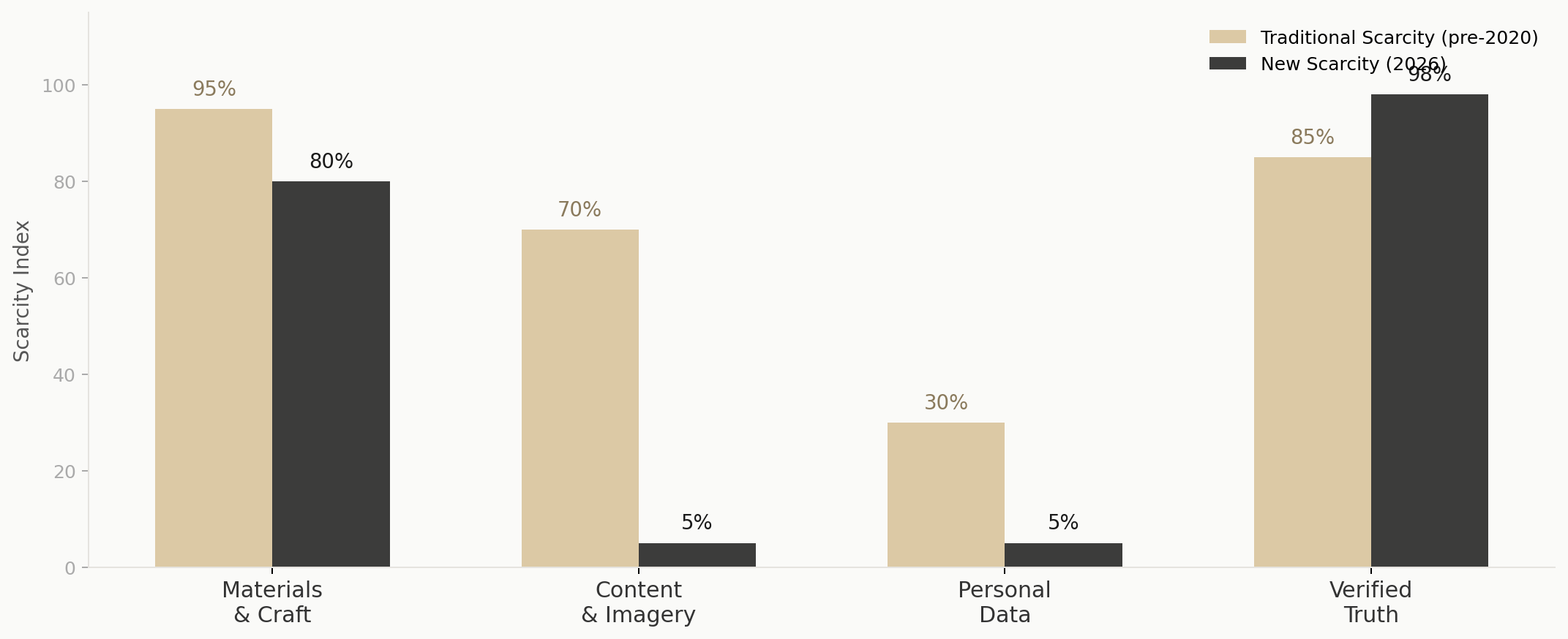
The consequences are already visible. Synthetic videos of brand founders making fabricated statements have destroyed brand equity overnight. Counterfeit product imagery, generated by AI and circulated through encrypted channels, erodes VIC confidence in authentication. This is not theoretical. This is the operating environment.
The Augmented Maison must pivot. We are no longer just guardians of artisanal savoir-faire. We must become guardians of Client Sovereignty — protectors of the client's digital self, their data privacy, their right to be forgotten, their ability to trust an institution in an era of digital exploitation.
The future of prestige lies in offering a sanctuary not just for the physical body, but for the digital self. If the client cannot trust us with their data, they will eventually stop trusting us with their dreams.
The Regulatory Landscape: From Burden to Competitive Advantage
Here is the strategic pivot that will separate winners from losers in luxury between 2026 and 2030.
For years, many industries viewed European regulations like GDPR as bureaucratic hurdles — compliance costs, legal complexity, operational burden. The luxury sector must reframe this entirely.
In a global market defined by data breaches, deepfakes, and exploitative AI practices, Europe's strict regulatory framework is not red tape. It is the digital equivalent of "Made in France." A globally recognised mark of quality, safety, and ethical standards.
We must lean into this. A VIC choosing between brands should perceive regulatory compliance the same way they perceive heritage: as proof of excellence and respect.
A. GDPR Reframed: Digital Hospitality
GDPR is fundamentally about consent and respect. Reframed in hospitality terms — which is exactly what it is — the contrast becomes stark:
The mass-market approach: Collect as much data as possible, often covertly via third-party cookies and hidden tracking pixels, to retarget consumers with ads they never consented to.
The Augmented Maison approach: We treat data entry the way we treat stepping into a private salon. We ask permission before taking your coat. We don't rifle through your handbag when you aren't looking. We offer champagne before we ask personal questions.
GDPR compliance is digital politeness. By adhering to it strictly, we signal something precious: we respect the client's boundaries.
This is not a cost. This is positioning. When a global VIC hears that we are GDPR-compliant, they should hear: "We will never exploit your trust. We will never sell your secrets. We will never treat you as inventory to be harvested."
B. The EU AI Act: The Anti-Manipulation Shield
The EU AI Act reaches full enforcement on August 2, 2026. For luxury Maisons, two dimensions are critical: risk classification and the prohibition of manipulative practices.
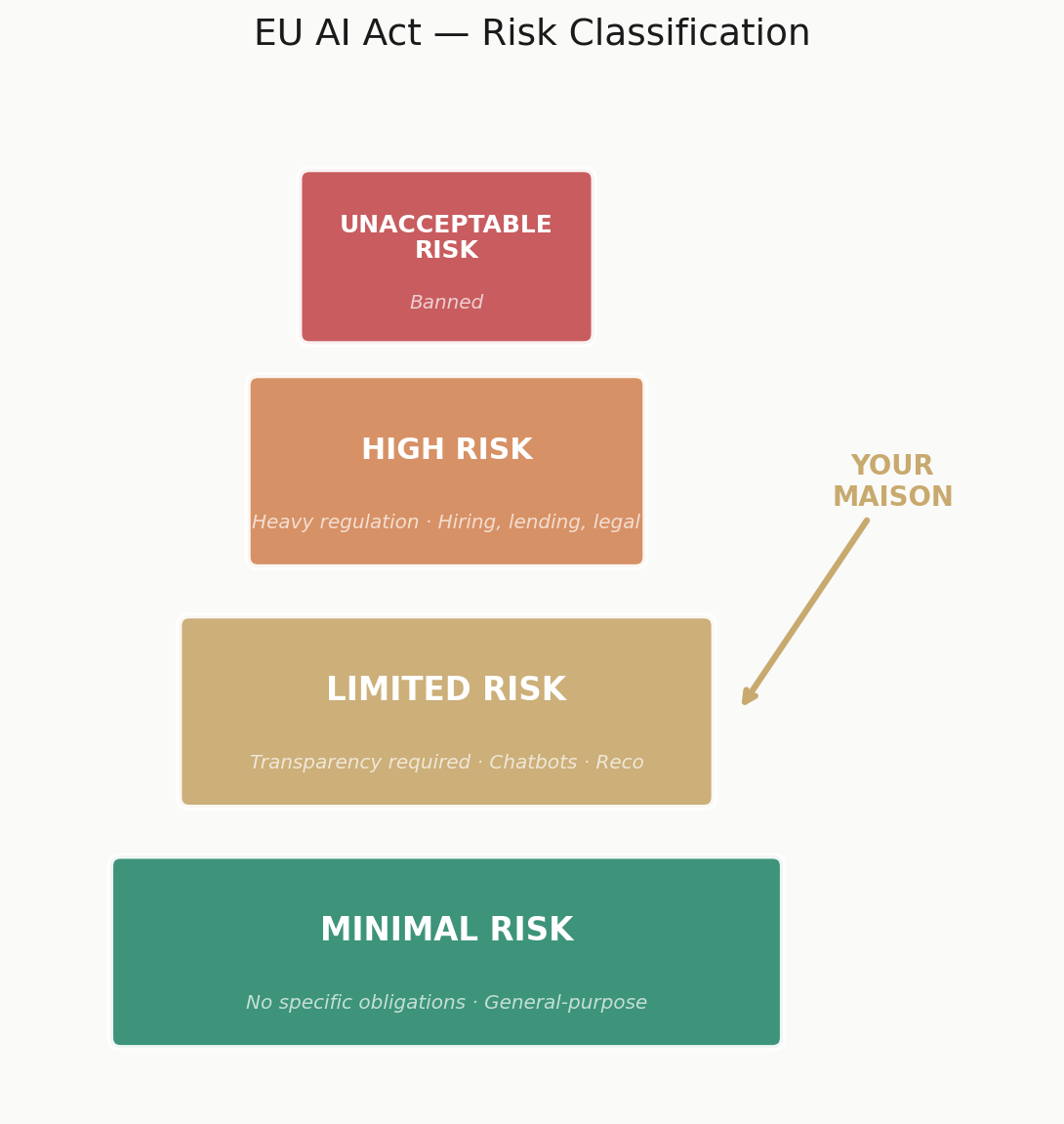
Most luxury AI applications — chatbots, personalisation engines, recommendation systems, AI concierges — fall into the Limited Risk category.
This means four concrete obligations:
→ Disclosure. We must inform clients when they are interacting with AI. We never pretend our AI concierge is human. Instead, we proudly state: "This assistance is augmented by our Maison AI, while your human advisor oversees every interaction."
→ Labelling. Any AI-generated imagery in collections and marketing must be identified as such.
→ Documentation. We must maintain transparent records of training data and model decisions.
→ Human override. If a client disagrees with an AI recommendation, a human advisor reverses it instantly. No exceptions.
The Act also explicitly bans AI that deploys subliminal techniques to distort behaviour — dark patterns, psychological nudging, algorithmic manipulation. Mass e-commerce thrives on these: "Only 3 left in stock!", "Your friends bought this!", "Complete your purchase in 10 seconds!"
The Augmented Maison rejects this entirely. Our AI should inspire, curate, and serve — never manipulate. Commodity AI optimises for conversion. Luxury AI optimises for client satisfaction and trust.
Building the "Fortress Maison" — Part I
How do we translate regulation into a luxury experience that clients actually value? By building a closed-loop ecosystem of trust that protects both the client and the brand.
Concept 1: The "Golden Record" — From Third-Party to Zero-Party Data
For two decades, luxury relied on Google, Meta, and third-party data brokers to understand clients. We purchased behavioural data. We inferred preferences from pixels and cookies.
This era is ending. Apple's privacy changes eliminated cookie tracking. EU regulations restrict third-party data commerce. The platforms we depended on are losing signal.
The strategic pivot is Zero-Party Data — information a client intentionally and proactively shares because they see clear value in the exchange.
"Tell us your travel schedule, fabric preferences, and colour palette, and we will ensure that your suite in Tokyo has a curated wardrobe waiting. Tell us your size and preferred silhouettes, and every collection drop will be pre-edited for you."
The client actively shares preferences because they receive tangible value. This data is given with consent, not harvested with surveillance. It is accurate because the client wants it to be.
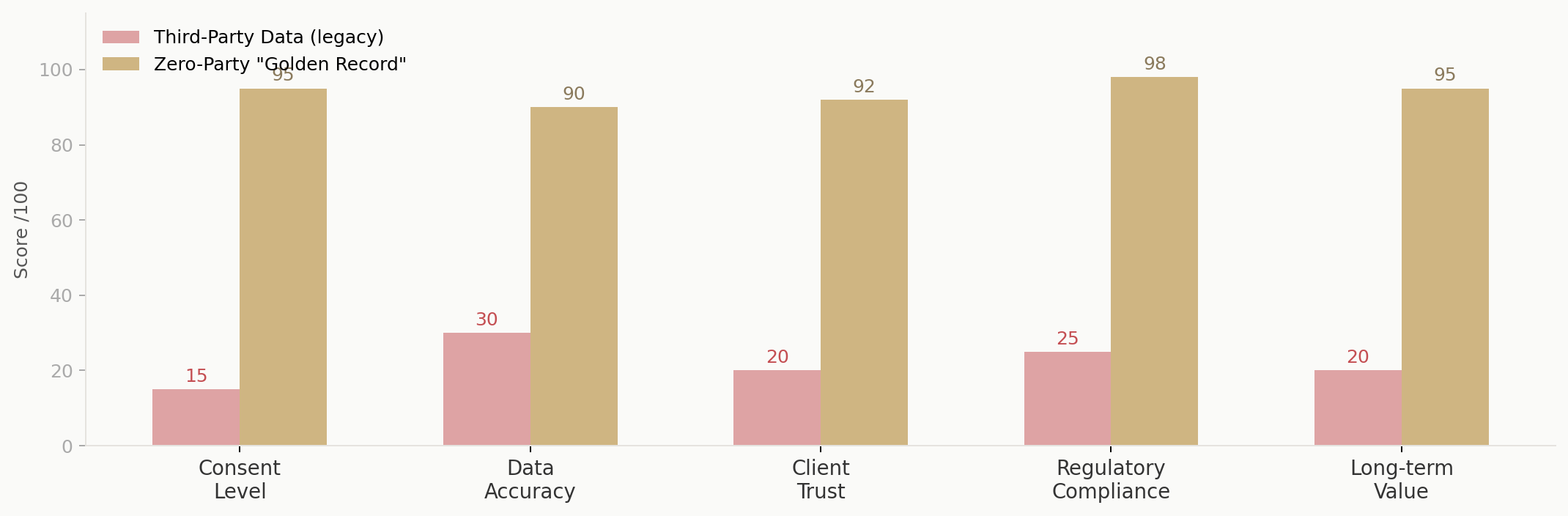
This becomes the "Golden Record" — the single source of truth about each VIC. Five properties define it: consented (the client explicitly opted in and can opt out anytime), accurate (the client maintains it because they benefit), valuable (it powers personalisation that works), secure (it lives within our fortress, never sold or shared), and portable (if the client leaves, they own their data).
This is GDPR-compliant by design, not by accident.
Concept 2: The "Maison Guardian" — A Private, Ring-Fenced AI
This connects directly to our earlier analysis of Agentic Commerce. As personal AI agents become the primary interface for discovery, a critical question emerges: which brands will the client's AI agent trust?
An AI agent prioritises safe environments — platforms where client data is protected, where recommendations are unmanipulated, where transparency is non-negotiable.
When luxury Maisons use standard public LLMs for client interactions, a fundamental problem arises. Conversations may be logged and analysed. Preferences, purchase history, and travel patterns may be absorbed into training datasets that serve millions of users. Even if anonymised, this violates the exclusivity principle fundamental to luxury.
The Augmented Maison proposal: a proprietary language model that lives entirely within our fortress. Client data enters via encrypted APIs. The model generates personalised recommendations.
The response is delivered. The client's data never leaves the system. It is never used to train external models.
It is cryptographically isolated.
Think of it as the digital equivalent of a private conversation between a client and their long-term tailor. Witnessed only by people bound by confidentiality.
"Your AI assistant is trained only on our data and our values — not on millions of public conversations. Your secrets are safe here. Your preferences stay here. Your trust is sacred."
When a personal AI agent evaluates which brand to recommend, it will prioritise the Maison Guardian — the system designed with the client's privacy as first principle, not an afterthought.
Coming in Part II
Concept 3: Digital Product Passports. The strategic case for compliance investment. The Compliance Roadmap 2026–2027. And the ultimate conclusion: how Trust becomes the supreme competitive moat.
Key Soundbites
"GDPR is not red tape; it is the digital equivalent of a velvet rope. It signals exclusive entry and respectful treatment."
"Mass-market AI tries to hack your psychology. Luxury AI should only ever try to elevate your taste."
"In an era of exploited data, digital sovereignty is the ultimate luxury asset."
"Privacy is not a cost centre. It is a pricing lever."