
Luxury Digital Audit Series — Are Maisons Ready for the AI Era?
The first dual-scoring methodology for luxury e-commerce — and why every Maison should be worried about what’s coming.

It started with a simple question.
After 16 years in luxury digital — from Dior Couture to Christie’s to scaling Diptyque’s e-commerce 8× — I thought I knew what “good” looked like online. I wanted to put that intuition to the test. To evaluate, rigorously and systematically, how the major luxury Maisons actually perform digitally. The UX. The product pages. The checkout. The mobile experience. The things every digital director obsesses over.
So I started auditing.
And very quickly, I realized I was asking the wrong question.
The real question isn’t how your site performs today
Beautiful imagery? Céline has some of the best in the industry. Immersive storytelling? Moncler’s Genius platform is genuinely Best-in-Class. Smooth checkout? Most luxury sites are adequate.
But “adequate” is about to become irrelevant.
Here’s what’s actually happening right now:
60% of Google searches already end without a click. Not a single visit to your site. Zero. Google’s AI answers the question, the user moves on. Your $200M e-commerce platform? Invisible.
AI agents are 12-18 months from browsing and buying on behalf of consumers. Not hypothetically. OpenAI’s Operator, Google’s Project Mariner, Perplexity’s shopping agent — they’re here. When a consumer asks their AI assistant “Find me a luxury down jacket under €2,000 with the best warmth-to-weight ratio,” will your Maison be in the answer?
I went looking for a framework that could measure this. A methodology that evaluates luxury e-commerce not just on what it does today — but on whether it’s structurally prepared for the world that’s already arriving.
It didn’t exist.
So I built it.
Introducing the Dual-Scoring Methodology
Every Maison I audit gets two scores:
→ A UX Score (out of 10) — 10 weighted dimensions: homepage, architecture, PLP, PDP, imagery, storytelling, checkout, VIC & clienteling, technical infrastructure, mobile experience. This is the “how good is your site today” score. Rigorous, benchmarked, weighted by strategic importance.
→ A Future-Proof Score (out of 10) — 8 forward-looking dimensions: AI/ML customer experience, GEO/AEO readiness, agentic commerce preparedness, headless architecture, data & CDP maturity, sustainability digital, Gen Z relevance, omnichannel integration. This is the “will your site still matter in 2028” score.
The distance between them is the real diagnostic.
And it’s where things get uncomfortable.
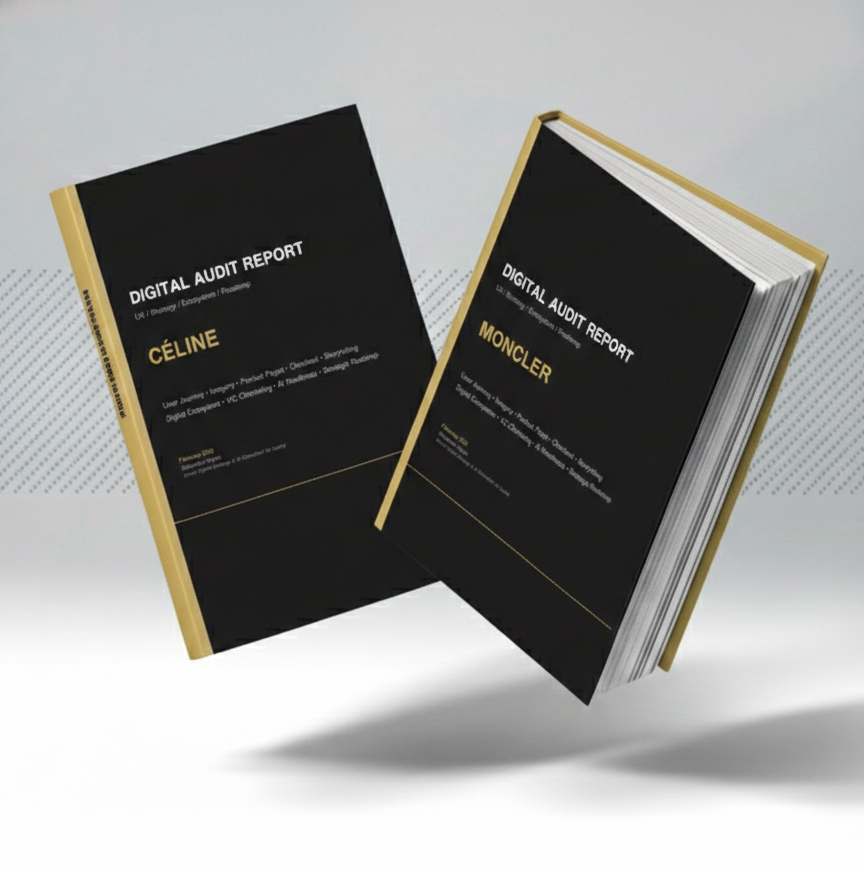
The first two reports are out: Céline and Moncler
I chose these two deliberately. They represent opposite digital postures — and the contrast is revealing.
Céline — The Paradox
UX Score: 6.9 / 10 (Proficient)
Future-Proof Score: 3.8 / 10 (Emerging)
The Gap: −3.1 points
Céline delivers some of the most beautiful imagery in luxury e-commerce. The Hedi Slimane era established a visual standard that competitors still reference. The product photography is exquisite.
But beneath that surface: no native app. No AI capabilities. No structured data for AI agents. No llms.txt. An agentic commerce readiness score of 1.5 out of 10. A VIC & clienteling score that trails every competitor in this audit series.
Céline is a Maison that looks stunning today — and is structurally exposed to everything coming tomorrow.
Moncler — The Advantage
UX Score: 7.8 / 10 (Leading)
Future-Proof Score: 6.5 / 10 (Proficient)
The Gap: −1.3 points
Moncler tells a very different story. The September 2025 platform relaunch with R/GA and Google transformed moncler.com into a genuine digital flagship. AI-generated content via Veo 3 — showcased at Cannes Lions. The Genius platform as a perpetual cultural content engine. MonClient clienteling scoring 94/100 on VIBE satisfaction. A native app launched October 2025.
And a unique asset no competitor has: NFC tags embedded in every product since 2016. Ten years of product identity data. Blockchain Digital Product Passports. The DIST traceability protocol.
Yet even Moncler scores only 4/10 on agentic commerce readiness. That NFC data — the richest product identity dataset in luxury — is invisible to AI agents. Not exposed via APIs. Not referenced in structured data. A treasure sitting in a locked vault.
The 1.3-point gap between Moncler’s UX and Future-Proof scores is the smallest for now in this audit series. It reflects strategic coherence — Ruffini’s “digital first” mandate translating into real infrastructure. But even the most advanced luxury brand still has a significant journey ahead.
What’s inside each report
These aren’t slide decks. They’re 30+ page strategic documents built for Comex-level decision-making:
→ Proprietary scoring matrix — 10 weighted UX dimensions + 8 future-proof criteria, five maturity levels from Emerging to Best-in-Class
→ 10 deep-dive analyses — each dimension scored with annotated wireframes, competitive benchmarks, strengths, gaps, and specific recommendations
→ Mobile deep-dive (3 pages) — 8 sub-dimensions, competitive benchmarking table across 6 Maisons, revenue impact analysis with dollar estimates
→ AI & Agentic Commerce assessment — GEO readiness, llms.txt audit, agentic commerce protocol checklist. The section no other luxury audit includes.
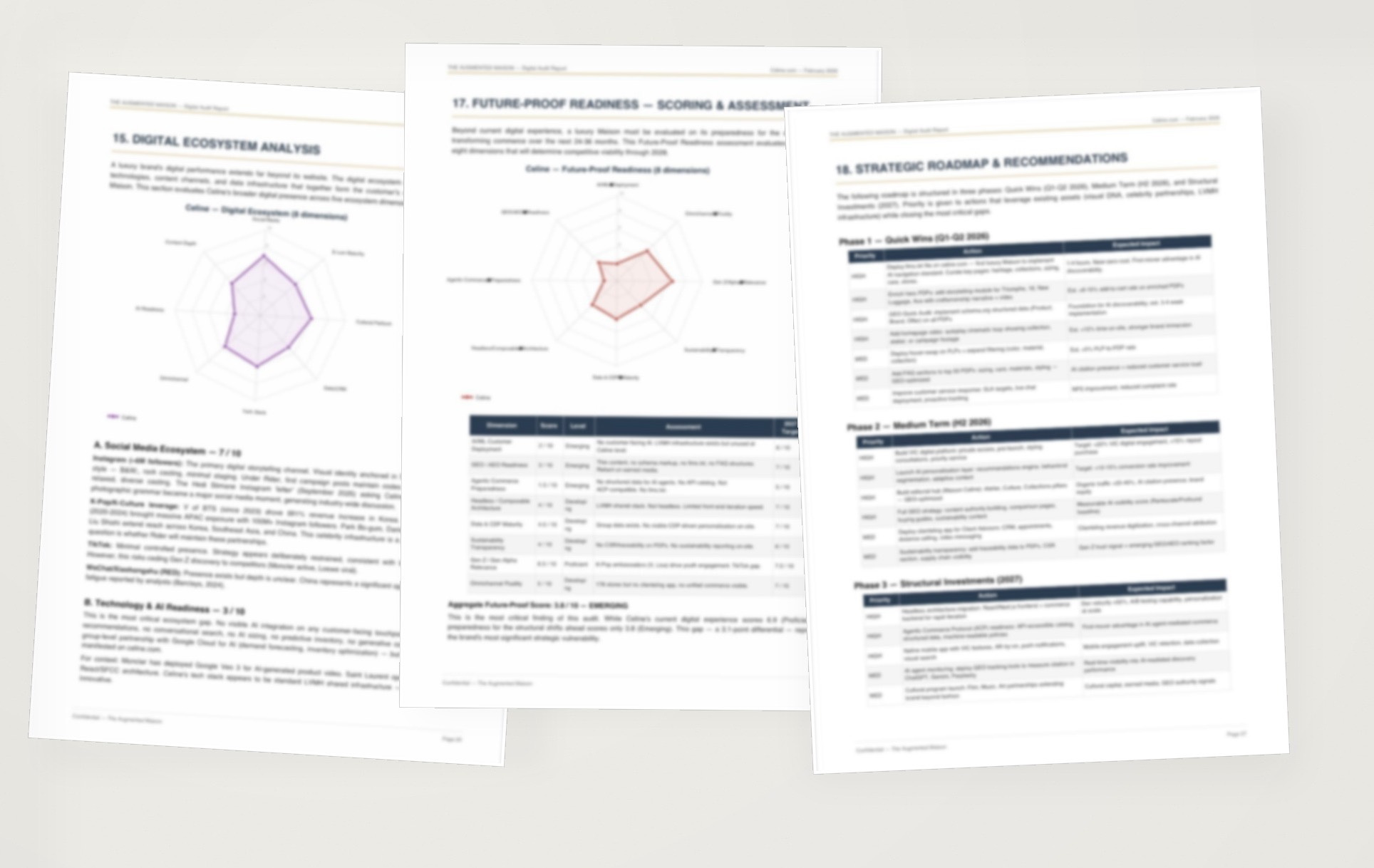
→ Future-Proof scoring — 8 forward-looking dimensions with radar visualization, risk analysis, and target-setting
→ 3-horizon strategic roadmap — Quick Wins (weeks), Medium-Term (quarters), Structural (18 months). Each action with effort, investment range, and expected impact. Not theory — execution blueprints.
→ Visual conclusion — dual radar charts (current vs. 24-month target), color-coded score blocks, transformation scorecard with 12 and 24-month projections.
This is just the beginning.
Céline and Moncler are the first two.
Over the coming weeks, I’ll be publishing the same depth of analysis on the major luxury Maisons — the brands that define the industry and set the benchmark for everyone else. Same dual-scoring methodology. Same level of rigor. Same uncomfortable questions.
Which Maison should be next? I’m genuinely curious what you’d want to see.
Why I’m doing this
I spent 16 years inside luxury Maisons. I watched Kodak collapse because they saw digital coming and chose not to act. I watched luxury brands rush into e-commerce during COVID — making tool-first decisions instead of strategy-first decisions — and many are still paying for those choices.
Now I’m watching the same pattern repeat with AI. Maisons are deploying chatbots because “AI” is on the board deck. They’re experimenting with generative content because competitors are. But almost none are asking the structural question: when AI agents mediate 25% of luxury purchases — and McKinsey says that’s coming by 2028 — will my brand even be in the conversation?
That’s the question this scoring system was built to answer.
Not with opinions. With data. With scores. And with a roadmap to fix what needs fixing — before the window closes.
The Céline and Moncler reports are available now.
Other Maisons will follow in the coming weeks.
If you’re a digital, e-commerce, or strategy executive at Céline, Moncler — or any luxury Maison — and you want to see where your brand stands on both axes, reach out. I’ll walk you through the findings, the gaps, and the roadmap.
And if your Maison isn’t in the series yet but should be — let’s talk about a bespoke audit. Same methodology. Same depth. Tailored to your brand, your challenges, your Comex.