
FROM POINT OF SALE TO POINT OF EXPERIENCE
How to arm our staff with data to turn them into Ambassadors of empathy

THE PIVOT TO VICs
Customer Acquisition Cost in luxury has hit critical levels. The numbers reveal an industry in distress:
Luxury CAC: $175+ per customer—the highest of any retail sector1
CAC has risen significantly since 2023, while new customer acquisition volumes have declined year-over-year—a pattern consistent across the sector as inflationary pressures and rising competition compress margins.
LTV/CAC ratio in decline: Sustainable luxury marketing requires a 3:1 ratio. Most brands now operate below this threshold, indicating margin compression and inefficient acquisition economics.2
The verdict: We are spending more to acquire fewer clients. The growth-at-all-costs model is mathematically dead.
The future of the Maison relies entirely on Lifetime Value (LTV)—specifically, the top 2-3% of clients (our VICs) who drive 30-40% of revenue.
Bain & Company data shows the top 2% of luxury customers account for approximately 40% of sales.3 Mytheresa, the luxury e-commerce leader, reports that just 3% of its customer base generates 30% of its total revenue.4
THE PROBLEM WITH TRAINING STAFF FOR YESTERDAY
The problem is acute: We are training our floor staff like it’s 2015.
We train them on product specs and POS systems, converting them into glorified inventory checkers. When a client can get specifications from an AI agent instantly, the human associate becomes redundant. They transform into a transaction processor in a world that no longer needs transactions.
The goal of technology in retail is not to replace the human; it is to give the human superpowers. We must transition our teams from “Sales Associates” (focused on the transaction) to “Augmented Ambassadors” (focused on the relationship).
This is our counter-strike to Agentic Commerce. While agents automate the sale, we automate empathy.
ACTIVATING THE “SHADOW CLIENT” VIA THE “WHISPER”
In my first article, I introduced the “Shadow Client”—the digital data trail that every consumer leaves behind. Currently, this data sits idle in CRM silos or is used for generic email blasts.
In the Augmented Maison, this data is mobilized to the front lines in real-time. We call this “The Whisper.”
This isn’t science fiction. Enterprise wearables—smartwatches and discrete earpieces—are already deployed in logistics and warehouse management, reducing response times by 25%. The technology is proven. What’s missing is the integration with VIC data in the boutique context.
The vision
Imagine a Client Advisor on the floor of the Bond Street boutique. A VIC walks in. The Advisor doesn’t need to run to an iPad to check their history. Via a subtle smartwatch notification or a discreet earpiece, our Maison’s AI “whispers” critical context.
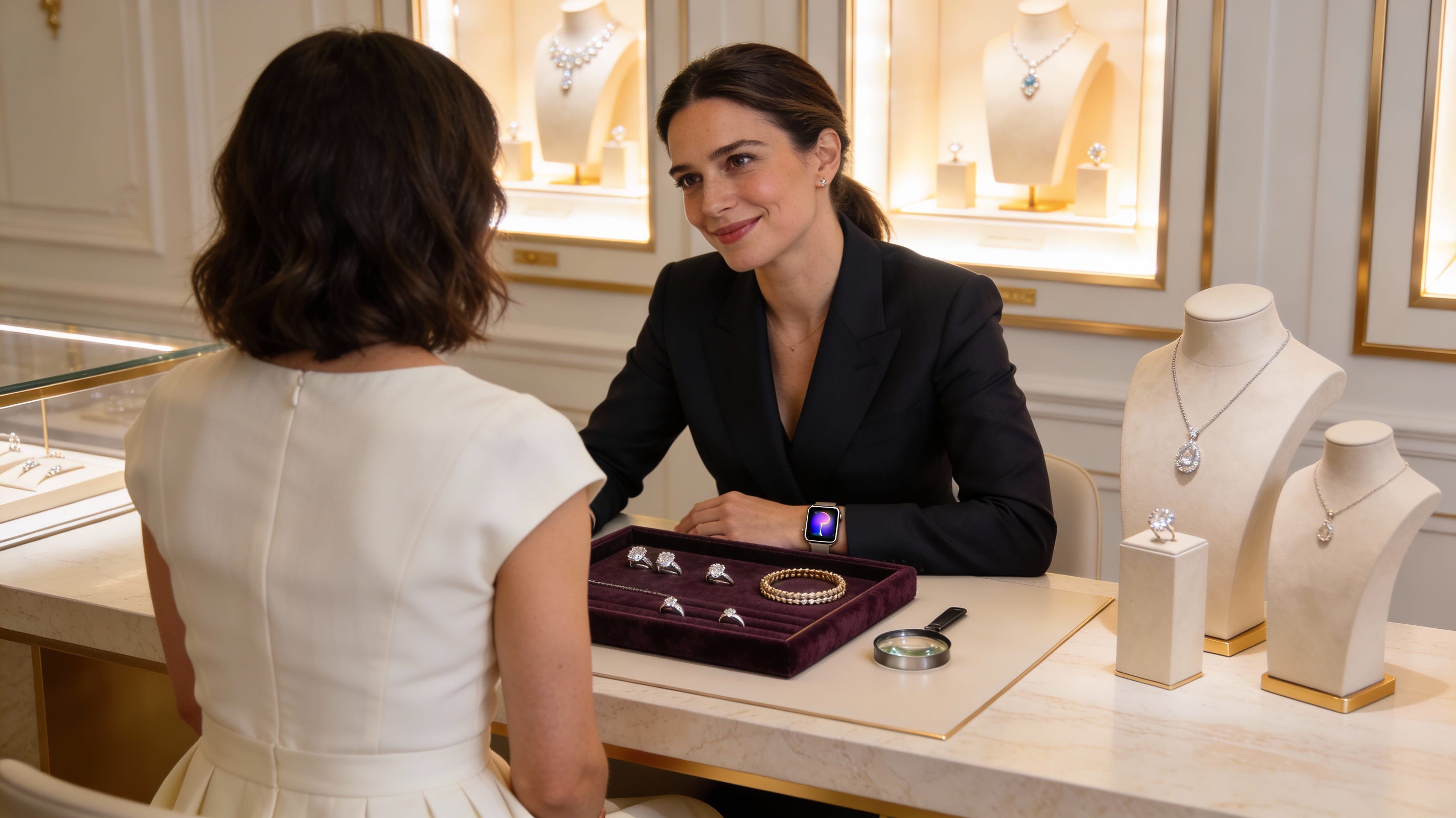
It’s not just what they bought. It’s why.
The Old Way (Data): “Client bought the sapphire necklace in 2023.”
The Augmented Way (Intelligence): “Client bought the sapphire necklace for her daughter’s wedding last year. The anniversary is next week. Suggest the matching earrings as a commemorative gift.”
This isn’t selling; this is high-stakes hospitality. The technology handles the remembering, so the human can handle the relating.
This shift from transaction focus to relationship focus is where we reclaim the human advantage. No AI agent can replicate the feeling of being recognized. No algorithm can manufacture the warmth of a person who remembers not just your purchase, but the story behind it.
THE THREE NEW PILLARS
This shift requires a redefinition of the staff’s role. We need to borrow less from retail management principles and more from 5-star hotel concierge principles.
The Augmented Ambassador has three new pillars, powered by data:
Pillar 1: Radical Anticipation
We don’t wait for demand. We preempt it.
If our Digital Flagship detects a top client browsing cashmere wraps online for three days while traveling in Tokyo, the local store manager should be alerted to prepare a selection before the client even thinks about visiting the boutique.
Hermès mastered this playbook with their traveling exhibition “Hermès in the Making.” They don’t wait for VICs to express interest in heritage craftsmanship. Instead, they stage educational experiences in key markets (Shenzhen, Paris, Tokyo) and alert select clients who match predicted interest profiles. The client arrives expecting a traditional exhibition; they experience a bespoke tutorial on techniques they didn’t know existed.
This is Radical Anticipation: not predictive analytics, but preemptive delight.
Our Ambassadors become curators of possibility. They pre-stage collections, prepare special orders, and arrange private viewings—all because data told them what the client wanted before the client articulated it.
Pillar 2: Hyper-Personalized Curation
Our AI analyzes each VIC’s past purchases, returns, and online browsing to create a “Confidence Score” for new products. When the new collection arrives, the Ambassador receives a prioritized list:
“Show Mme. Laurent the structured blazer (95% match based on past tailoring purchases); do NOT show her the oversized knits (she returned similar items twice).”
This eliminates wasted time. More importantly, it makes the client feel deeply understood. The Ambassador isn’t randomly showing collections. They’ve curated a selection that feels personal, even if the algorithm suggested it.
The data informs the Ambassador’s eye. It doesn’t replace their judgment.
Pillar 3: Frictionless Utility
Checkout must be invisible. The Ambassador should be able to complete the transaction on a mobile device while sitting on a sofa with the client, sipping champagne. The “Point of Sale” is wherever the client is sitting.
No signature pads. No terminal handoffs. No “excuse me while I process this.” The transaction dissolves into the experience. The moment of purchase becomes so seamless that it feels like a natural conclusion to the conversation, not an interruption.
THE “UNCANNY VALLEY” OF SERVICE: A CRITICAL WARNING
There is a massive danger here, and we must name it explicitly. Luxury is built on discretion. If personalization is too blunt, it becomes creepy and surveillance-like.
Bad execution: An Advisor says, “I see you were looking at the red bag on our website last night at 11:47 PM.” The magic dies. The client feels tracked, not understood. They leave. The technology became surveillance.
Luxury execution: The Advisor, armed with data, says, “Since you love structured pieces for work, I thought you might appreciate the cut of this new jacket.” The client has no idea that the data revealed their preference. It feels like a natural observation from someone who knows them.
This is the critical distinction: Data should be the prompter in the advisor’s ear, never the script in their hand.
The art of the “Hospitality Algorithm” is knowing what data to use and what data to ignore. The data should inform the Ambassador’s intuition, not replace their social intelligence.
The goal is to move from “Can I help you find something?” to “I’ve been expecting you, and I’ve prepared this selection just for you”—and the client should feel that warmth came from human judgment, not algorithmic sorting.
Get this balance wrong, and we transform the boutique from a sanctuary into a panopticon. Get it right, and we transform it into the most personalized experience luxury has ever offered.
THE HUMAN MOAT
In an era of Agentic Commerce, any brand can automate a transaction. Only a Maison can automate empathy.
We’re not fighting the algorithm. We’re orchestrating it. We’re using technology to amplify what makes human connection irreplaceable: the feeling of being recognized, anticipated, and served by someone who understands your unspoken desires.
By arming our staff with intelligence, we transform the physical boutique from a place where you buy things into a place where you go to be known. In a cold digital world, the feeling of being truly “known”—not by data scraping, but by genuine human attention—is the ultimate luxury.
This is the counter-strike. While agents commodify transactions, we deepen relationships. While algorithms replace mediocre service, we elevate great service into artistry.
The Augmented Ambassador is not a retail worker. They are a custodian of relationship capital, armed with technology that lets them scale empathy without losing humanity.
References & Data Sources
Deliberate Directions, 2025. “Customer Acquisition Cost Benchmarks for Ecommerce in 2026.” Luxury ecommerce brands face acquisition costs exceeding $175 per customer.
LTV/CAC Ratio Guide. “What is a good LTV to CAC ratio?” Industry benchmark of 3:1 is standard across SaaS and retail sectors for sustainable unit economics.
Bain & Company / Business of Fashion. “How Luxury Brands Court the 1 Percent.” Top 2 percent of customers account for approximately 40 percent of luxury sales.
Business of Fashion, 2024. “Selling Luxury to the 1%: Case Study.” Mytheresa reports that 3 percent of its customer base generates 30 percent of total revenue.