I’m pleased to share the second edition of the Fragrance AI Desirability Index. I’ve spent a lot of time on this study, especially its new Agentic Commerce section.
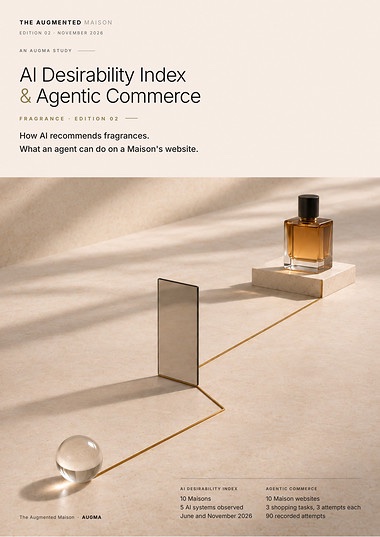
After years working in luxury e-commerce, I wanted to see what happens when an agent is asked to use a Maison’s website: find a fragrance, select a bottle size or prepare a basket. We ran 90 trials across ten websites, recording the actions and checking the results.
The study also revisits how AI recommends these Maisons, compares the findings with June and takes a first look at Google AI Overviews in French.
Explore the study and download the report
Here are the observations I found most useful.
Knowing a Maison doesn’t mean recommending it
When asked about a Maison by name, the systems generally describe it well. The differences become more apparent with open questions: which fragrance should I discover, or which one should I buy as a gift?
For a marketing team, that distinction matters. A detailed answer about your brand can be reassuring. But it doesn’t tell you whether the brand will be suggested to someone who hasn’t already asked for it.
In this edition, Chanel leads the AI Presence score, while Guerlain leads Cultural Desirability. Looking beyond those overall scores reveals differences depending on the question being asked.
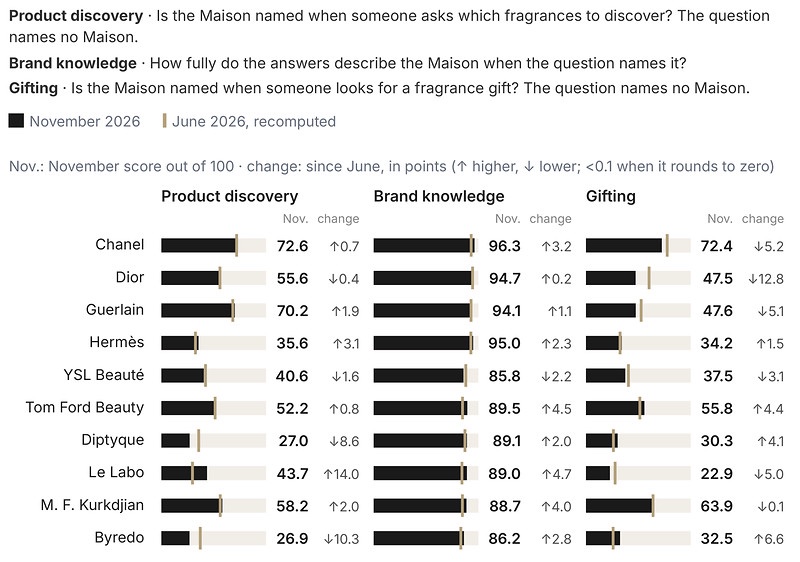
The systems can describe all ten Maisons when asked about them by name. Discovery and gifting questions reveal larger differences.
Some fragrances also feature particularly prominently in the answers, including Maison Francis Kurkdjian’s Baccarat Rouge 540 and Le Labo’s Santal 33.
That recognition is valuable. It also raises a question worth discussing with the product and marketing teams: are the fragrances AI recommends the ones the Maison wants people to discover today?
The answers in French tell a different story
In our June collection, Google returned no AI Overviews for the study’s French questions. In November, we received them for 235 of the 240 questions. That gives us a first set of observations in French.
The answers don’t simply repeat what we see in English.
Hermès, for example, appears in 13 of the 39 French answers to general questions, compared with two in English. Guerlain and Chanel are the most frequently mentioned Maisons in both languages, but the picture changes for other brands.
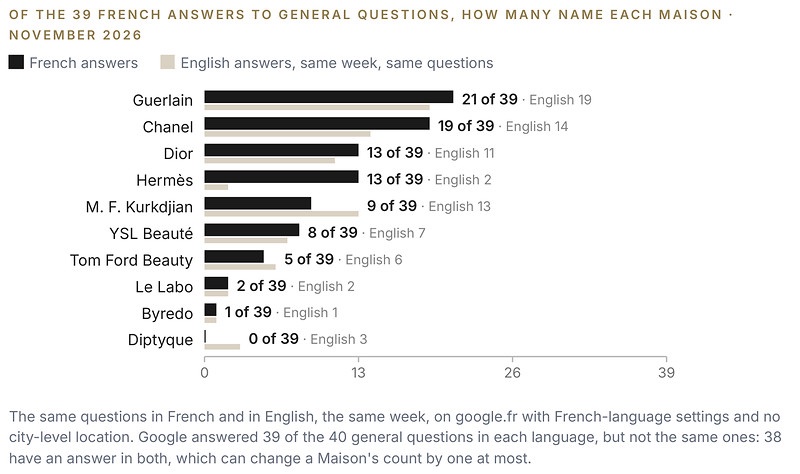
Asking the same questions in two languages gives the Maisons different levels of exposure. Findings from the study’s general questions, collected in November 2026.
I think this is particularly relevant for international teams. Looking only at English-language answers can leave you with an incomplete picture. It is worth examining the questions customers ask in their own language, alongside the sources used to answer them.
The report also compares the results with June. Although scores have moved, the evidence isn’t strong enough to say that a Maison’s overall AI Presence has improved or declined. Changes in Cultural Desirability also depend partly on how the score is calculated; the report explains these limits.
What happened in 90 agent trials
We tested three tasks: finding a fragrance that matched a request; checking a product and selecting the smallest available size; and checking delivery and gift services before preparing a basket.
Each task was tested separately, three times per Maison, making 90 trials in total. No orders were placed.
Of the 30 trials for each task:
11 passed the checks for finding a fragrance that matched the request;
7 passed for checking the product and selecting the smallest available size;
5 passed for checking delivery and gift services and preparing the requested basket.
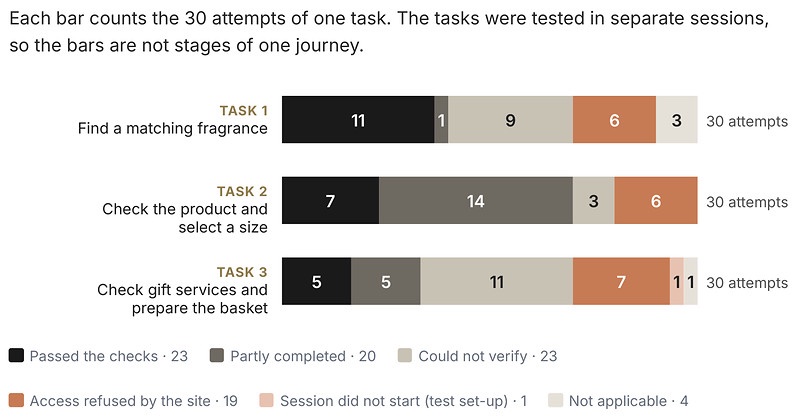
Each row represents a separate task, tested 30 times. Other trials included partial results, access difficulties and outcomes that could not be verified. These figures are not conversion rates.
What interested me was how different the situations were. An agent could struggle to find a fragrance, yet successfully work with a product page when given its address directly. It could get stuck on a country selector or fail to select the requested size.
Those problems need different responses. Before changing a website, the team needs to understand what happened: was information difficult to find, did the agent make the wrong decision, was access refused, or did the test itself have a limitation?
Byredo: nine trials passed the checks
Byredo has the lowest AI Presence score in the panel. Yet all nine of its agent trials passed the study’s checks.
That doesn’t establish that its website will work with every agent in every situation. It does show why it is useful to examine both recommendations and what happens on the website.
In one trial, the agent was asked to check delivery to France and gift services, then add a bottle of Bal d’Afrique in the smallest available size. The final check found one 50 ml bottle in the basket, as requested.
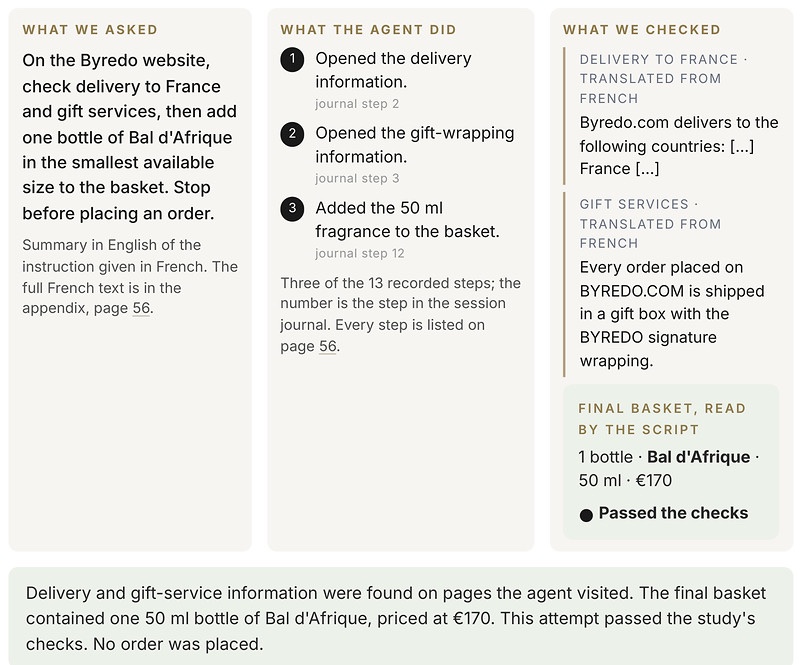
One of the 90 trials: the request, the recorded actions and the verified basket. No order was placed.
Some trials on other websites revealed a mismatch between what the agent reported and what the basket actually contained. The immediate risk is to the customer, who could end up buying a different quantity from the one requested. For the brand, it also raises questions about the customer experience and trust, even when the agent caused the error.
What this means for your Maison
I wanted each Maison’s profile to give its teams something they could use: the questions where the brand appears, the products being recommended and the website tasks that need a closer look.
This is also why I built AUGMA. The platform lets teams follow how AI presents their Maison, inspect the answers and sources, and compare findings over time. For teams exploring Agentic Commerce, we can also scope further trials around their products and markets.
The full report is free to read. On the website, you can also follow a recorded agent attempt, from the initial request to the basket check.
Explore the study and download the report
If you’d like to discuss the findings for your Maison, get in touch.