
DESIGNING FOR EMOTION IN THE AGE OF AGENTS
Why we must build a Digital Flagship in a world where humans no longer browse

It is 2026. The era of “Search, Filter, and Compare” is soon over.
As I discussed in my previous analysis, the tedious labor of e-commerce has been outsourced. Our client will be no longer visiting our website to check if the tote bag is available in burgundy, or to compare shipping rates. Their AI Agent—be it embedded in their OS or a specialized shopping concierge—will do that (if not already done). It (will) knows our inventory, our carbon footprint, and our pricing better than most of our store associates.
This shifts our paradigm violently. If the utility of our website is gone, delegated to a machine, what remains for us to build?
The answer is the Dream.
We are facing a core paradox: As the transaction becomes automated, our destination must become emotional. We can no longer afford to build “Points of Sale” optimized for click-through rates. We must build “Points of Immersion.”
If our website is just a catalog, we are merely feeding data to the Agents. We become suppliers, not Maisons.
1. Designing for the “Two Visitors”
To survive in an agentic world, our Augmented Maison’s Digital Flagship must be architected for two distinct VIPs who visit us simultaneously, but see completely different realities.
Visitor A: The Silicon VIP (The AI Agent)
This visitor is invisible, ruthless, and moves at the speed of light. It does not care about our beautiful hero video, our typography, or our heritage storytelling. It craves one thing: Truth.
What it sees: Structured Data. It reads our “Maison Protocol” via high-fidelity APIs.
Our Strategy: We must expose our inventory (in real-time), our sustainability credentials (digital product passports), and precise sizing data.
The stakes: If our data is messy, hidden, or hallucinated, the Agent cannot “read” our brand. In the eyes of the algorithm, we simply cease to exist. Worse, if our stock data is unreliable, the Agent will lose trust and stop recommending us. Our backend quality is now our reputation.
Visitor B: The Biological VIP (The Human Client)
This visitor arrives only after the Agent has done the heavy lifting. The Agent says: “Here are the three bags that match your criteria.” The human clicks the link.
What they see: A Vibe Check. Since the functional work is done, our landing page must be pure emotion.
Our Strategy: No pop-ups. No “Sign up for our newsletter.” No aggressive clutter. Just cinematic storytelling, texture, and atmosphere.
The Goal: Desire. The human visits not to buy, but to validate that the item feels like a piece of art.
The AI Agent wants the specs; the Human wants the spell. Our Digital Flagship must deliver both.
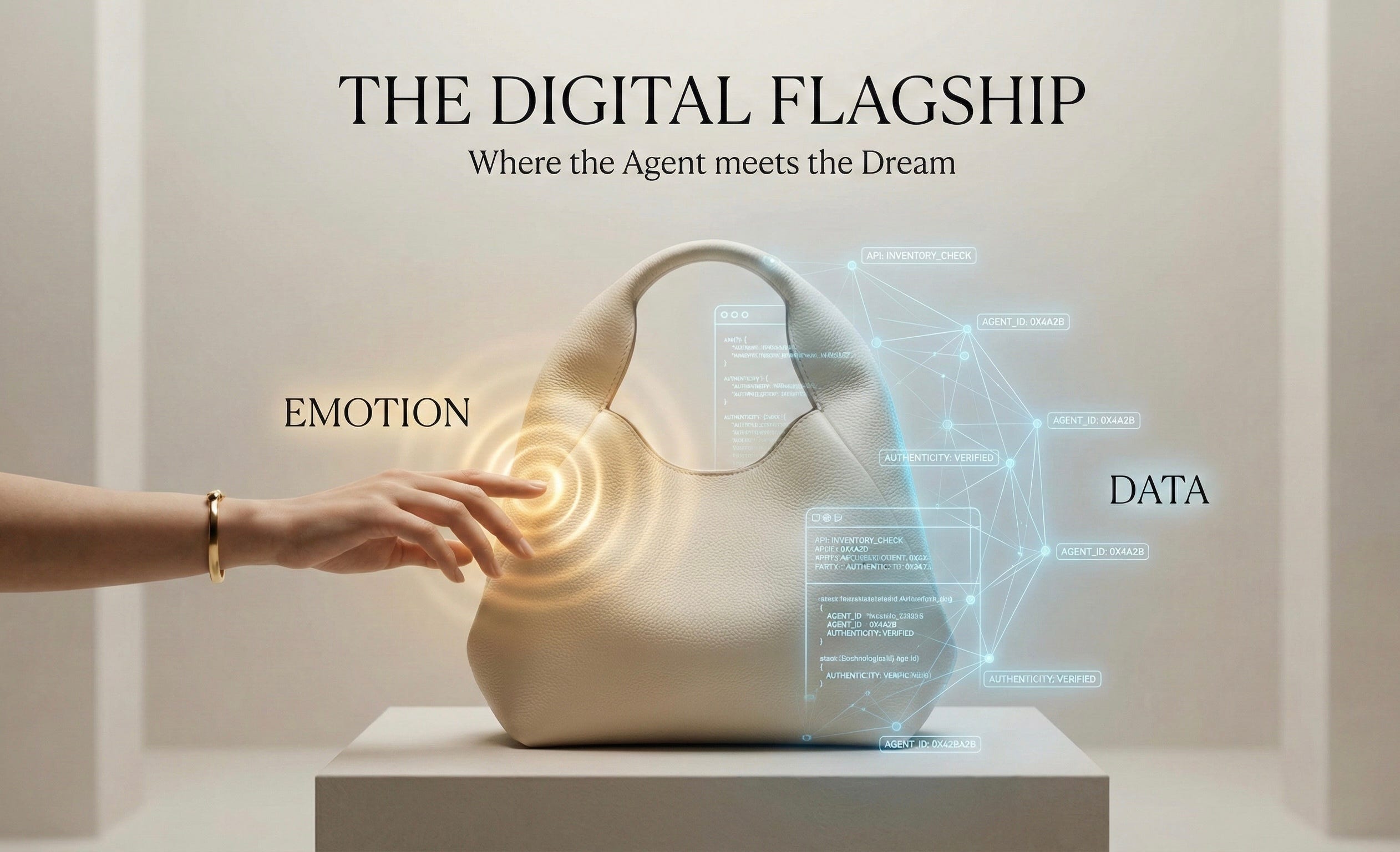
2. “Every Pixel Weighs as Much as Limestone”
Most of our sites today still look like high-end vending machines. Rows of packshots on white backgrounds. We are often still trapped in “Online Store” thinking, a relic of the 2010s.
Our Digital Flagship must mirror the gravity and sensuality of our physical boutiques on Avenue Montaigne or Bond Street.
Lighting & Atmosphere: Does our interface adapt from day to night? Does the digital light caress the material?
Service as a Feature: Is our “Add to Cart” button a generic icon, or is it an invitation? For our high-value items, it should be a “Request a Private Viewing” or “Speak to an Expert.”
The “Sensory” Web: We need to use soundscapes and fluid motion to slow the user down.
A note on Friction: In the golden age of conversion optimization, friction was our enemy. In the age of Luxury Agents, we must distinguish between Technical Latency (bugs, slowness, which are unacceptable) and Ritual Friction.
Ritual Friction is the deliberate slowness of unboxing a ribbon. It is the cinematic pause before a collection is revealed. In an agentic world, speed is for the machine; time is for the human.
We should stop optimizing for speed and start optimizing for “Goosebumps per Minute.”
3. The Unified Nervous System (The Quiet Revolution)
A beautiful front-end is nothing without a Unified Commerce brain.
Our Digital Flagship cannot be a silo. It must be the central nervous system of the Maison, holding the “Single View of Inventory” and the “Single View of the Client.”
Consider this scenario:
An AI Agent books an appointment for a client to view a handbag. It passes the Context to our boutique’s system. When the client walks through the door, our Store Manager doesn’t just see “Appointment at 2 PM.”
They see: “Client hesitated on the Figuier scent online, is looking for a gift, and values sustainable products.”
The digital handoff makes the physical welcome magical. This is not just technology; it is hospitality.
The Sanctuary
In 2026, we don’t “go online” to buy. We buy via agents, often without looking. We “go online” to escape.
Our Digital Flagship is the Sanctuary where the brand’s soul resides. It is the only place left where the client can experience our brand without the filter of a third-party algorithm or a marketplace interface.
It is the place where we reclaim our narrative.
So, let us look at our current digital expressions. Let us ask ourselves: Is this a vending machine for an algorithm? Or is it a sanctuary for a dreamer?