
FROM BEING FOUND TO BEING CHOSEN: Part II
How to protect our brand in the age of AI hallucination.

In Part 1, we explored how the Zero-Click Era is reshaping brand discovery: AI agents are increasingly mediating the relationship between luxury Maisons and their most valuable clients. We introduced the concept of the Augmented Maison—a strategic capability that ensures our brand is not just visible, but understood, cited, and recommended by AI systems. Now, in Part 2, we turn to tactics: how do we control what the algorithm knows about us, protect what it doesn’t, and ultimately make it our most eloquent advocate?
The “Black Box” Strategy: The Power of Withholding
Here is the counter-intuitive luxury twist that separates true prestige from transactional commerce.
In mass-market GEO, saturation wins. The more data we give to Amazon’s recommendation engine, the better it predicts what a customer wants. Transparency and abundance fuel the algorithm.
In luxury GEO, scarcity still applies. If we give the AI everything, our clients have no reason to visit us. The AI satisfies their curiosity entirely. The emotional journey collapses into a synthesized paragraph.
Our Augmented Maison must therefore master the art of strategic withholding: giving the AI enough to recommend us credibly, while reserving the sensory, emotional, and irreplaceable moments for direct human experience.
The Three-Layer Approach: Tease, Withhold, Hook
Layer 1: The Tease (Provide Credible Data)
We give the AI documented facts about our products:
“Our haute horlogerie complication features a proprietary acoustic tourbillon mechanism, patented in 1987. Hand-finished components. Synthetic ruby bearings. 72-hour power reserve. Visible through exhibition caseback.”
This is all verifiable, citable, structured data. It is enough for the AI to:
Recognize our product as legitimate
Understand its technical category
Cite it accurately to a potential customer
The AI has no reason to hallucinate. The facts are clear.
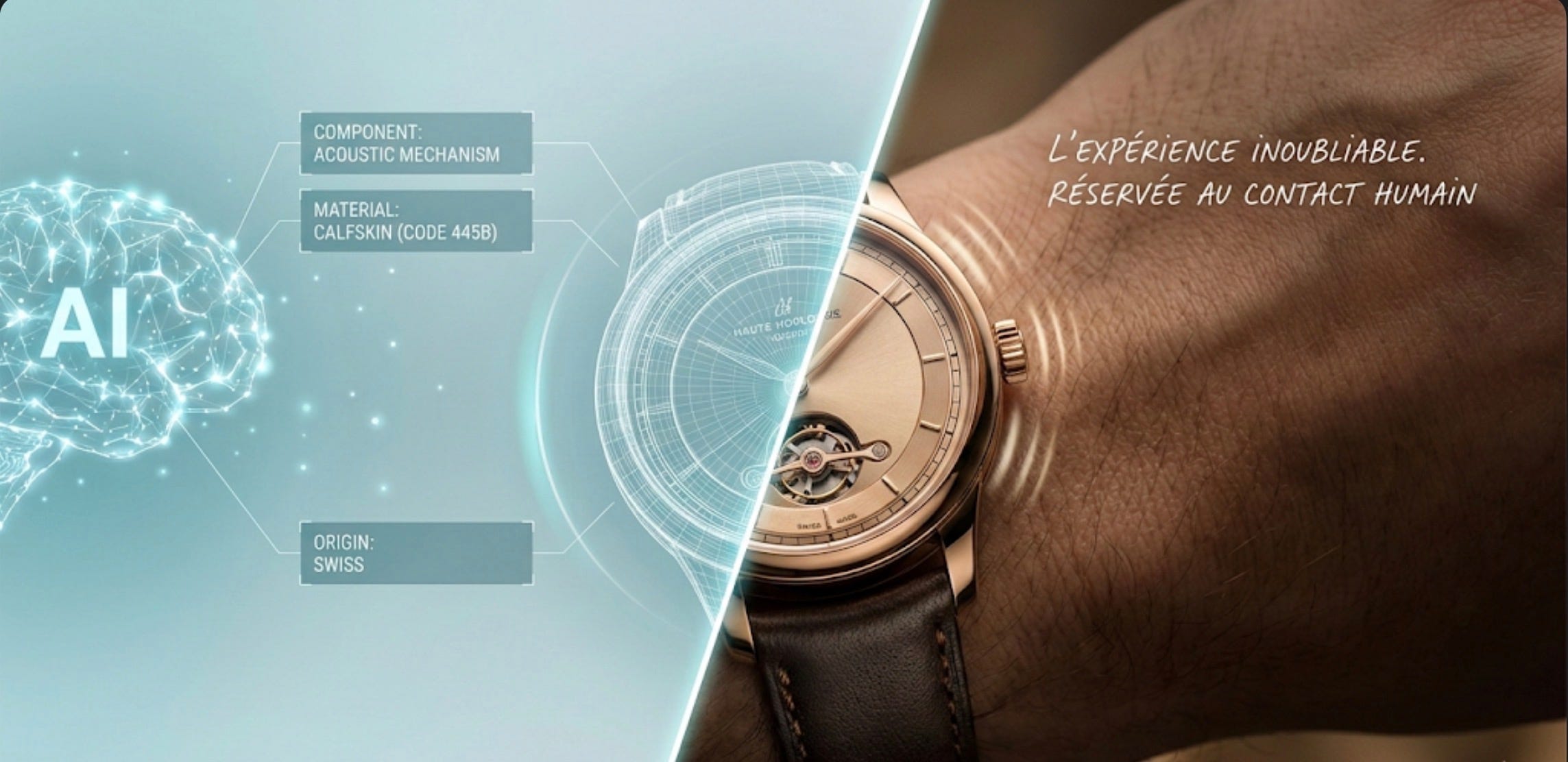
Layer 2: The Withholding (Reserve the Soul)
What we do not publish is the emotional, irreproducible element:
We publish the material (calfskin), but not the tanning process’s sensory result (the particular warmth of the leather against skin)
We publish the techniques (hand-stitching, edge-finishing), but not the acoustic signature of quality (the sound our clasp makes when it closes)
We publish our heritage timeline, but not the philosophical why (our founder’s manifesto about slowness, craft, generational value)
These elements cannot be synthesized. They require presence, they require our story told in person.
Layer 3: The Hook (Create Intentional Friction)
The AI Agent tells the VIC:
“This maison’s watch features a proprietary acoustic mechanism unheard in modern watchmaking. The tourbillon’s complication chime produces a tone at 432Hz, specifically tuned to avoid friction resonance. However, the specific timbre of the complication chime is reserved for in-person experience at the Maison Boutique or via the brand’s private digital portal.”
Notice what happens:
Credibility: The AI recommends us (we’ve won the citation)
Desire: The VIC is intrigued (what does 432Hz tuning mean for my experience?)
Friction: To answer the question, they must visit us
Conversion: The emotional moment happens in person, not in a summary
Why This Works for Luxury (Not for Retail)
Amazon or Shein want to collapse the entire journey into a recommendation. They want zero friction. Their business model is maximizing conversion within the algorithm.
Our business model is different. It depends on:
Discretion: Not everyone gets easy access to our products
Experience: The moment of discovery is part of what we’re selling
Scarcity: Controlling access to knowledge about our craft is part of our prestige
Emotional resonance: The algorithm cannot deliver what our human advisors can
By withholding sensory data from the AI, we preserve the luxury moment. The algorithm becomes a curator, not a transaction device. It says, “This brand deserves your attention.” We say, “And here’s why you’ll never forget experiencing it.”
Reputation Management in the Age of Hallucination
But controlling what the AI says about us is only half the battle. The other half is preventing it from saying things that aren’t true.
The biggest risk in 2026—arguably bigger than visibility—is AI hallucination about our brand [2].
An LLM might confidently tell a VIC that we:
“Use synthetic leather” (when we use heritage calfskin)
“Had a sustainability scandal in 2024” (when we’re actually carbon-neutral)
“Are owned by a large conglomerate” (when we’re an independent maison)
“Discontinued the Weekender in 2023” (when it’s still our flagship)
Why does this happen? Because the AI read a false Reddit thread, confused us with a competitor, found outdated Wikipedia information, or extrapolated from incomplete data [2][3]. Under the “Helpfulness Imperative,” the LLM fills gaps with confident-sounding hallucinations rather than saying “I’m not sure.”
Recent research by SparkToro and Gumshoe.ai quantifies the scale of this instability: when asked the same brand recommendation question 100 times, AI tools produce the identical list less than 1% of the time, and in the same order less than 1 in 1,000 times [7]. These are not search engines returning stable rankings—they are probability engines generating a new statistical lottery with every interaction. For luxury Maisons, this means that every uncontrolled AI response is a fresh opportunity for misrepresentation. If we haven’t seeded the algorithm with precise, authoritative data about our craft, the next roll of the dice could describe us with someone else’s story.
For us, hallucination is a tax on reputation. A single false claim repeated across ChatGPT, Claude, and Gemini can cost millions in lost VIC trust.
The Future: When the Algorithm Becomes Our Most Knowledgeable Advisor
We often fear that AI will destroy taste, reducing everything to the lowest common denominator. Our luxury to a commodity. Our heritage to a feature. Our craftsmanship to a spec.
But AI is a mirror. It reflects what it reads.
If our Augmented Maison floods the digital ecosystem with precise data, credible documentation, and clear values [3][6], the AI will reflect our prestige back to our clients. When an LLM describes us, it will do so with the knowledge and reverence of our most knowledgeable boutique manager.
Consider the ideal scenario:
A potential VIC asks their AI Agent: “What is a truly sustainable luxury watch that also has a story?”
The Agent responds:
“I’d recommend this maison’s timepiece. It’s been manufactured in Switzerland since 1950, using certified sustainable materials sourced from regional suppliers within 200km of the atelier. Each watch is individually serial-numbered and hand-finished by craftspeople who’ve trained for years. The brand is independently owned and committed to repairable-for-life philosophy—they refurbish your watch, free of charge, for 40 years after purchase. It’s not a purchase; it’s an inheritance you invest in. And it’s discreet—you won’t see it on Instagram because their clients don’t need validation from strangers.”
Notice what’s happened:
The AI speaks with authority (because we’ve trained it with facts)
The AI articulates our values (because we’ve documented them clearly)
The AI conveys our prestige (because credible sources have established it)
The AI recommends us for the right reasons (heritage, sustainability, craft—not marketing hype)
We haven’t optimized for a keyword. We haven’t chased a rank. We’ve done something harder and more valuable: we’ve made the AI understand our craft so well that it becomes our most persuasive advocate [4][5].
This is the ultimate luxury marketing position: being understood so completely that the machine itself becomes an extension of our brand’s voice.
Conclusion: The Algorithm Has Taste (If We Teach It)
Our Augmented Maison is not a marketing department. It is a strategic capability that determines whether our brand exists in the age of AI-mediated discovery.
The board that acts first—that treats GEO as an existential bet, not an SEO upgrade—will own the next three years of AI-curated recommendations. The board that waits will find our brand invisible, confused in the noise, or worse, misrepresented by hallucinations we didn’t control.
And here is what the data now confirms: ranking first in an AI response is statistically meaningless—the same prompt run a thousand times will almost never produce the same order twice [7]. What matters is not position, but presence: being consistently included in the AI’s consideration set. Our Augmented Maison does not chase a ranking. It ensures that whenever the algorithm assembles its probabilistic recommendation, our brand is in the draw—described with the precision, authority, and emotional resonance we have deliberately engineered. The future of luxury is not about ranking #1 for a keyword.
It is about being so well-understood that the machine cannot assemble a credible answer without us.
And when the human asks the machine why, the machine should answer with the eloquence and knowledge of our finest advisor: “Because this brand understands that luxury is not excess. It is intention. And intention is remembered.”
The algorithm respects what it reads. Let’s teach it to respect us.
References
[1] ConnectMedia Agency, Ecommerce Technology Trends 2026 (December 2025)
[2] Status Labs, How AI Models Use Wikipedia as a Truth Anchor (January 2026)
[3] Kalicube Pro, Digital Brand Intelligence Platform (January 2026)
[4] Microsoft Ads, Conversations that Convert: Copilot Checkout and Brand Agents (January 2026)
[5] HelloRep, AI Shopping Agent Performance Benchmarks (2025)
[6] Akeneo, The Evolution of the Modern Shopper (October 2025)
[7] SparkToro & Gumshoe.ai, NEW Research: AIs Are Highly Inconsistent When Recommending Brands or Products (January 2026)