
FROM BEING FOUND TO BEING CHOSEN: Part I
GEO and the Future of Luxury in the Zero‑Click Era

1. From “Blue Links” to “Golden Answers”
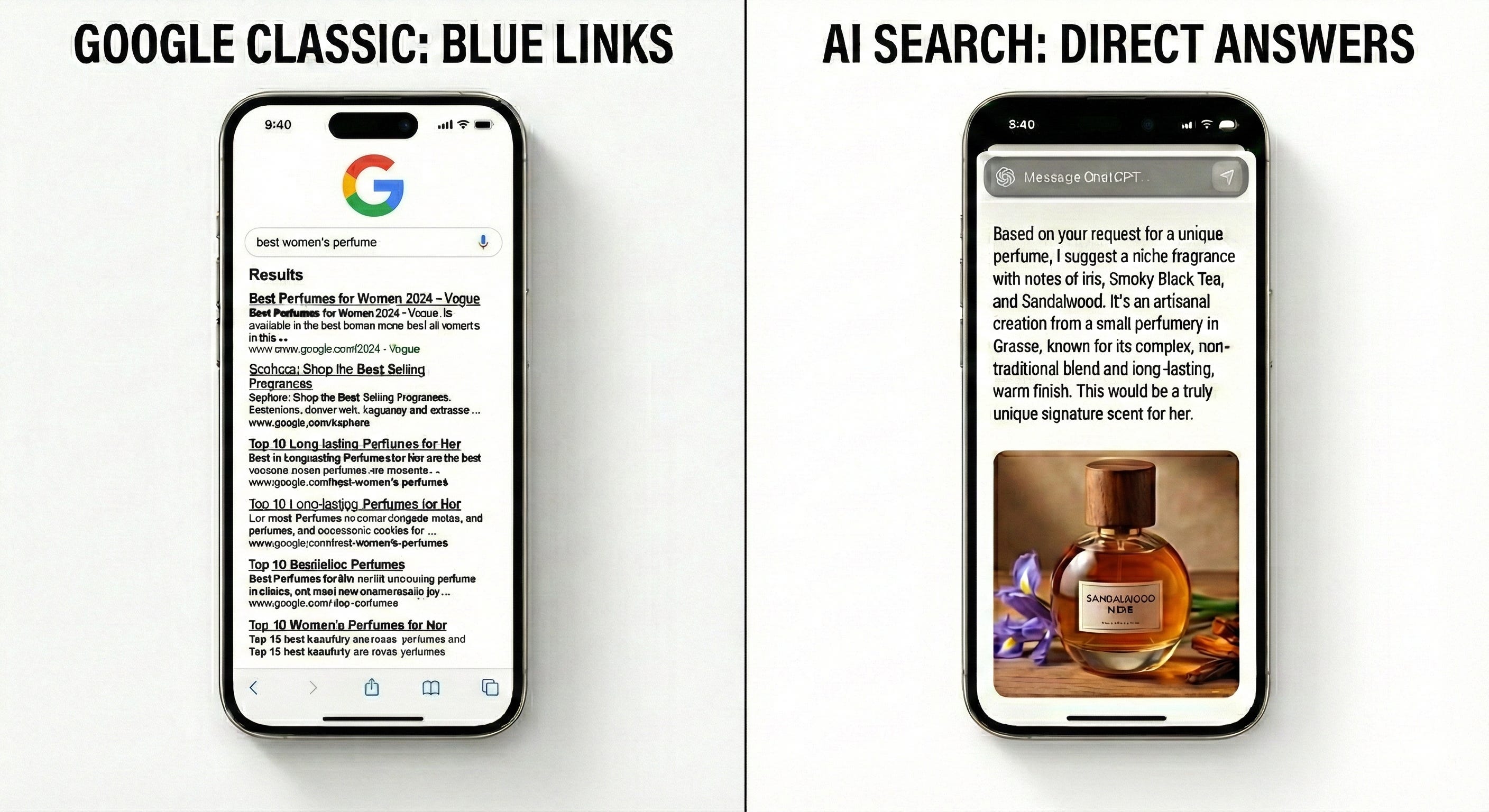
For two decades, the rules of digital visibility were stable: optimize for keywords, win positions in the top 10 blue links, capture a share of clicks. That framework will soon no longer governs how affluent clients discover and shortlist luxury brands in 2026.
On high‑value intents (“understated weekender bag for Gstaad,” “heritage steel watch,” “quiet luxury jewelry”), the primary interface is now an AI answer: a synthesized recommendation, not a page of results.
In this new paradigm, the outcome is binary for a Maison:
If we are cited in the synthesized answer, we exist in the client’s field of view.
If we are not cited, we are not “ranked low”—we are absent from the consideration set.
AI Overviews and similar formats already depress organic click‑through by around 60 % when they appear, while generative browsers and chat interfaces drive faster‑growing traffic with higher conversion than traditional search. Our SEO achievements remain in analytics dashboards, but they no longer decide who gets considered first.
2. What the last research changes: ranking is statistical noise
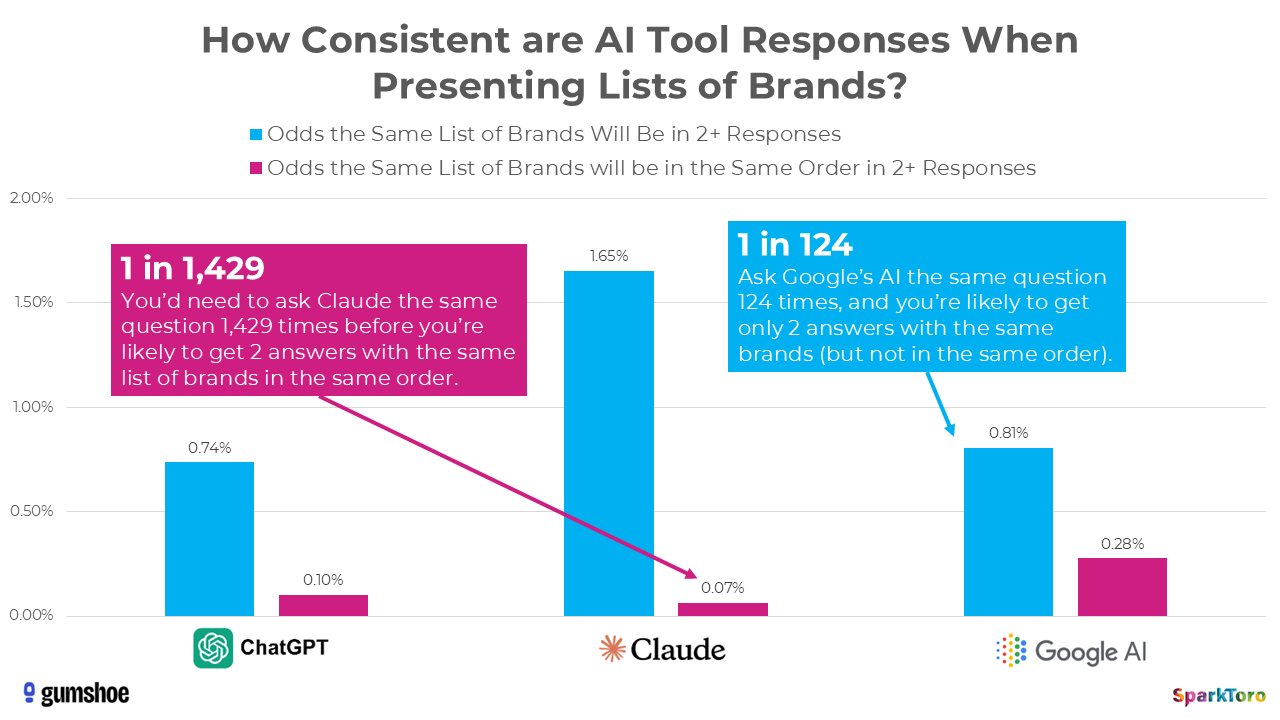
The SparkToro / Gumshoe study adds a critical piece: AI recommendation lists are highly inconsistent by design. Across nearly 3,000 runs of identical prompts on ChatGPT, Claude, and Google’s AI, they observe that:
There is less than a 1 % chance of seeing the same list of brands twice for the same prompt.
There is less than a 0.1 % chance of seeing the same list in the same order.
In other words, these systems are probability engines, not deterministic rankers. They are tuned to generate varied answers from a pool of plausible candidates, not to reproduce a stable “top 10”.
This has two direct implications :
Any tool claiming to track your “AI ranking position” is, in the words of the study’s authors, effectively selling nonsense—the position in a single answer is almost pure randomness.
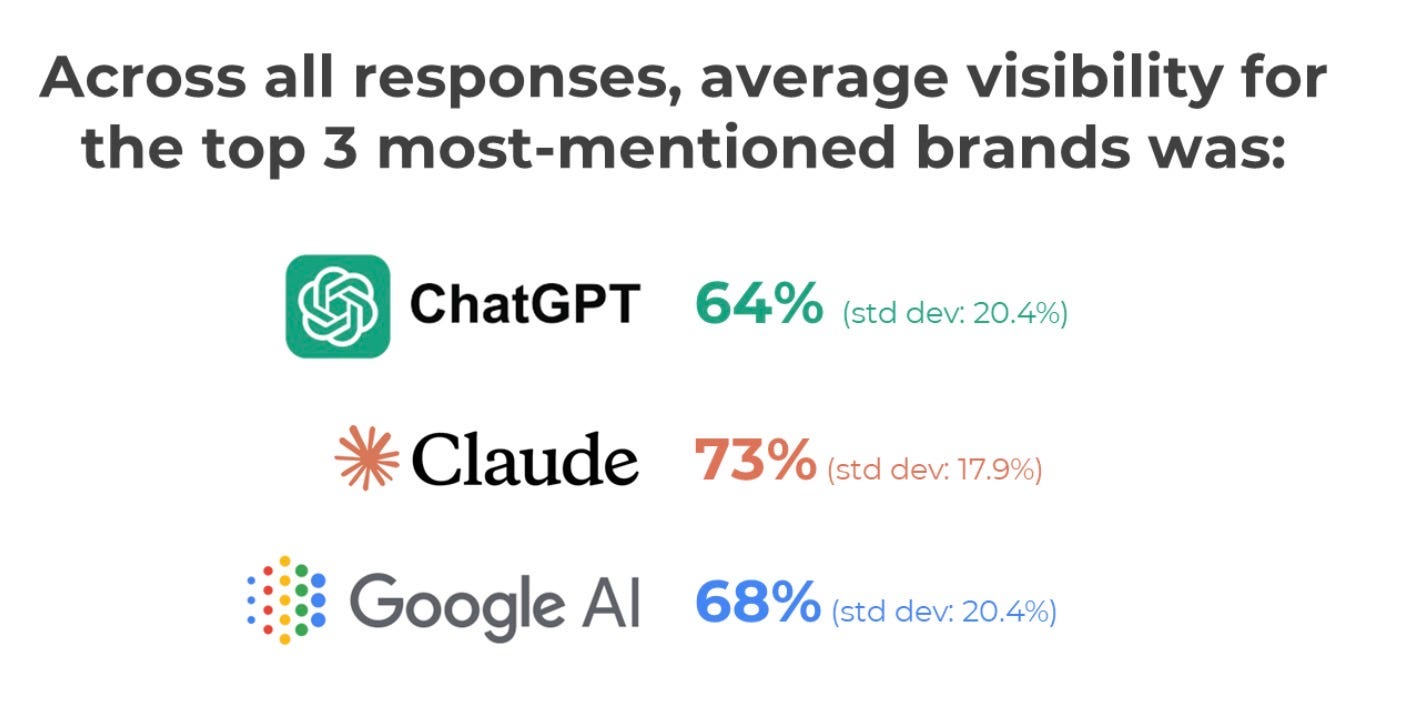
However, visibility over many runs—how often your brand appears across dozens or hundreds of answers for the same intent—is statistically meaningful and can be used as a proxy for whether you belong to the model’s internal shortlist for that topic.
The right mental model is therefore:
We cannot manage the exact slot where we appear in any one answer. We can increase the probability that we are part of the recommendation set whenever the intent is relevant.
3. Zero‑click as a probabilistic crisis, not a ranking crisis
The “zero‑click” phenomenon is no longer just fewer clicks from classic SERPs; it is the fact that the decision happens inside the AI answer, before the browser ever opens our site.
In that context, SparkToro’s research reframes the risk:
We are not competing for a fixed rank that can be monitored and optimized quarter after quarter.
We are competing for membership in a small, dynamic pool of “acceptable answers” that the model draws from each time it’s asked.
Across hundreds of outputs on a given topic (e.g., “best headphones for frequent travelers”), the study shows that a handful of brands (Bose, Sony, Sennheiser, Apple) surface in 55–77 % of the answers, despite each individual list being unique.
That is exactly the pattern luxury brands should aim for:
Not deterministic dominance in a single screenshot.
But persistent, high‑frequency presence across the messy, randomized reality of AI responses.
4. How AI actually chooses: authority, coherence, and depth of candidate pool
The SparkToro / Gumshoe work also confirms that what matters is not just our prominence in the real market, but how clearly we exist as a well‑documented entity in the model’s training and retrieval corpora.
Three forces shape whether we enter the “candidate pool” for a given intent:
Authority signals
Brands that repeatedly appear in credible sources—industry media, reference sites, structured knowledge bases, technical or financial publications—are more likely to be considered “safe” recommendations.
Coherence signals
When our founding dates, materials, prices, positioning, and product scope align consistently across our site, Wikipedia/Wikidata, press, marketplaces, and reviews, the model’s confidence rises; contradictory or sparse data pushes us out of the shortlist.
Category breadth
In narrow spaces (e.g., cloud providers or cancer hospitals), the same few entities recur with high visibility; in wide spaces (e.g., sci‑fi novels), visibility is more fragmented. Luxury categories often sit closer to the “narrow” side at the actual brand level (there are only so many Maisons that truly fit “heritage leather goods for UHNWIs”), which makes becoming a default candidate both possible and strategically decisive.
For a Maison, the message is clear: if our digital footprint is incomplete, inconsistent, or poorly structured, the model has little reason to include us in its candidate set. It will revert to better‑documented peers, regardless of historical prestige.
5. GEO : from ranking to “share of AI consideration”
Generative Engine Optimization (GEO) is the operational response to this probabilistic environment. It assumes the SparkToro findings rather than fighting them:
What GEO is not
It is not “SEO with GenAI lipstick.”
It does not try to “lock in” a position in a model that is deliberately randomized.
What GEO is
A discipline focused on increasing our share of presence in AI answers for a defined set of intents critical to our Maison (categories, usages, destinations, occasions).
A combination of technical groundwork and narrative authority that makes the model repeatedly select us as a plausible, safe, and differentiated answer.
The KPI shifts from:
Are we #1 on this keyword?
to:
Across a robust panel of prompts that map our category, in what percentage of AI answers do we appear, and how does that evolve over time vs. key competitors?.
This is the only AI visibility metric that both:
Respects the probabilistic, unstable nature of individual lists.
Provides a basis for strategic investment and accountability.
GEO is the art of shaping our digital footprint so that AI models recognize our brand as the definitive authority in our niche.
6. Strategic objective: become part of the model’s “mental shortlist”
The SparkToro article ends on a nuanced but powerful conclusion: rankings are essentially meaningless; visibility % across many prompts is not.
Transposed to luxury, the north star becomes:
To ensure that, whenever an affluent client agent expresses an intent in our territory, the model almost reflexively includes our Maison among a small, recurring set of recommended brands.
That requires:
Treating structured data, entity definitions (brand, founders, collections, boutiques), and real‑time feeds as core brand assets, not IT hygiene.
Systematically building co‑citations with authoritative sources so that the model learns stable associations between our Maison and a small number of strategic attributes (craftsmanship, heritage, innovation, discretion, resale value, etc.).
Measuring success not by where we appear in an inherently random list, but by how often we appear at all, given the intent and the competitive breadth of the space.
In a world of unstable brand lists and near‑random ordering, the real moat is to be in the shortlist that keeps coming back, run after run, client after client.
Coming in Part II: How to withhold information strategically (The Black Box Strategy), defend our reputation against AI hallucination (The Truth Defense Team), and the implications for the future of luxury marketing when the algorithm becomes our most knowledgeable advisor.
References
Akeneo, The Evolution of the Modern Shopper (October 2025)
Romanesko, GEO : Le nouveau SEO qui va tout changer - Guide 2026 (December 2025)
ConnectMedia Agency, Ecommerce Technology Trends 2026 (December 2025)
HelloRep, AI Shopping Agent Performance Benchmarks (2025)
SparkToro & Gumshoe.ai, “NEW Research: AIs are highly inconsistent when recommending brands or products – marketers should take care when tracking AI visibility”, January 2026. Available here
The reframing of AI visibility as probabilistic rather then deterministic is the key insight here. The shift from ranking to "share of consideration" actually mirrors how brand awareness worked in pre-digital luxury where consistant presence across curated touchpoints mattered more than any single placement. I've seen companies waste resources chasing specific AI outputs that change every time while ignoring the fundamentals of being well-documented across authoritive sources.