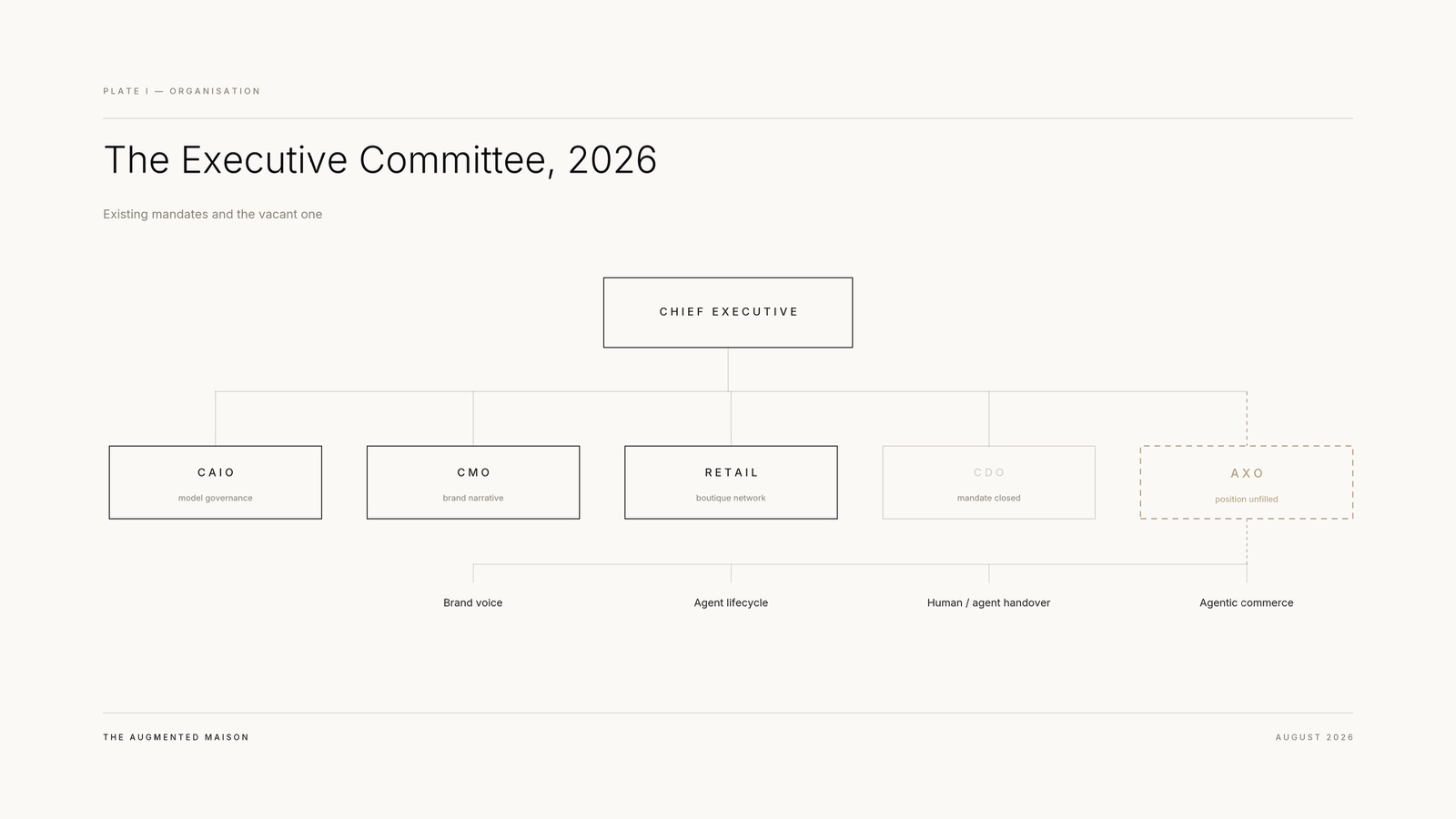
On 17 February I published Beyond the CDO: The Rise of the AXO. I argued that no existing Comex title covers the governance of autonomous agents that will soon speak with a Maison's voice, recommend its products and complete transactions with no human involved. I proposed a name for the role, the Agentic Experience Officer.
Six months later, I went to see what had happened. Nobody has created the position, as far as I know. Meanwhile, McKinsey has published a report describing the mandate, Chief AI Officer appointments have multiplied, OpenAI has given up on taking payment inside the chat, and Article 50 of the AI Act came into force on 2 August.
The May McKinsey report describes the mandate without naming it
On 29 May, McKinsey published When AI meets desire, seventeen pages on agentic commerce in luxury. The report asks the question from my February article: if AI interprets desire before the client reaches the brand, who governs that interpretation?
McKinsey calls this interpretive authority. A Maison has to write the rules by which an agent presents it. The firm goes further and asks that the sales advisor's judgment be turned into rules a machine can read and whose application an audit can check. I described that work in February as the first pillar of the AXO, the one that sets what an agent may say on the Maison's behalf.
The report's numbers set the stakes. 85 % of luxury consumers surveyed already use a general-purpose AI assistant to prepare purchase decisions, and 83 % report high satisfaction with it. Looking to 2030, clients expect 39 % of their luxury purchases to run through an agent, while merchants anticipate 47 % of interactions. Across global commerce, McKinsey values at 3 to 5 trillion dollars the volume agents could mediate by that date.
The report closes with a four-space framework, the Foyer, the Gallery, the Salon and the Atelier, which separates the moments where delegating to an agent creates value from the moments where it destroys value. That structure maps closely onto the four pillars I set out in February. The mandate now exists on paper from the most institutional of firms, with no holder named in any organisation chart.
Three large companies in four now have a Chief AI Officer
In February I wrote that the Chief AI Officer could not absorb the AXO mandate because the role thinks in models, tokens and compute costs. I stand by the argument, in a context that has changed scale.
According to the 2026 CEO study from the IBM Institute for Business Value, conducted with Oxford Economics across 2,000 executives in 33 countries and 21 sectors, 76 % of large organisations surveyed have a CAIO in 2026, against 26 % a year earlier. The figure is self-reported and the definition of the role remains loose, at SAP the title is merged with CTO. Those caveats aside, technical AI governance has found its owner in large-company leadership. The market is even inventing variants, with several sector forecasts naming a Chief AI Agent Officer tasked with auditing the rules of engagement between humans and autonomous systems.
These appointments cover models, data, risk and compliance. None covers what an agent may say to a VIC client at two in the morning, or the register in which it says it. In luxury, that responsibility carries more weight than the choice of a model.
OpenAI removed payment from ChatGPT
This is the event I did not see coming. In March, OpenAI ended Instant Checkout, the feature that allowed a purchase without leaving ChatGPT, six months after launch. The reasons were operational: users were researching products in the chat without buying there, only around a dozen Shopify merchants had gone live, and sales tax collection and inventory synchronisation were unresolved. OpenAI rolled out a new experience built around product comparison. OpenAI confirms this in the documentation it addresses to merchants. The client discovers and compares products inside ChatGPT, then completes the purchase on the brand's own site or app.
In February I was watching in-chat payment above all. OpenAI has handed it back to merchants. The assistant has kept the choice of which products it shows the client. A Maison now sees clients arrive on its site with a selection already made by a tool it does not control.
The rest of the infrastructure kept advancing meanwhile. Google launched the Universal Commerce Protocol at NRF in January, Microsoft adopted it in Merchant Center in April, and all three US card networks now support agentic commerce, with Mastercard live, Visa commercial and American Express adding purchase protection for registered agent transactions in April.
Article 50 of the AI Act has applied since 2 August
My February article listed the AI Act among the frameworks still to come. The text is now in force. Since 2 August 2026, the transparency obligations of Article 50 bind providers and deployers alike: a person has to know they are interacting with an AI system, and certain generated content has to be marked. The Commission published its final guidelines on 20 July and recognised the Code of Practice on Transparency of AI-Generated Content as a means of demonstrating compliance. Penalties reach 15 million euros or 3 % of worldwide annual turnover, and the text applies to any company whose systems reach European users.
Two calendar points are worth knowing. The Digital Omnibus, now formally adopted, defers high-risk obligations to December 2027 and August 2028 without touching Article 50. The machine-readable marking obligation under Article 50(2) carries a grace period to 2 December 2026 for systems already on the market before 2 August. The handover between human advisor and agent, which I placed at the heart of the third AXO pillar, is now a live legal obligation.
What luxury clients accept delegating
The McKinsey report supplies a figure my original article did not have: the measure of what luxury clients accept delegating.
Only 9 % of luxury consumers want full agent autonomy. 32 % prefer simple assistance, 31 % want options assembled for approval, 28 % will authorise action within set limits. Delegation comfort reaches 58 % for completing the transaction and falls to 39 % for service after the purchase, at the point where reassurance and discretion define the experience.
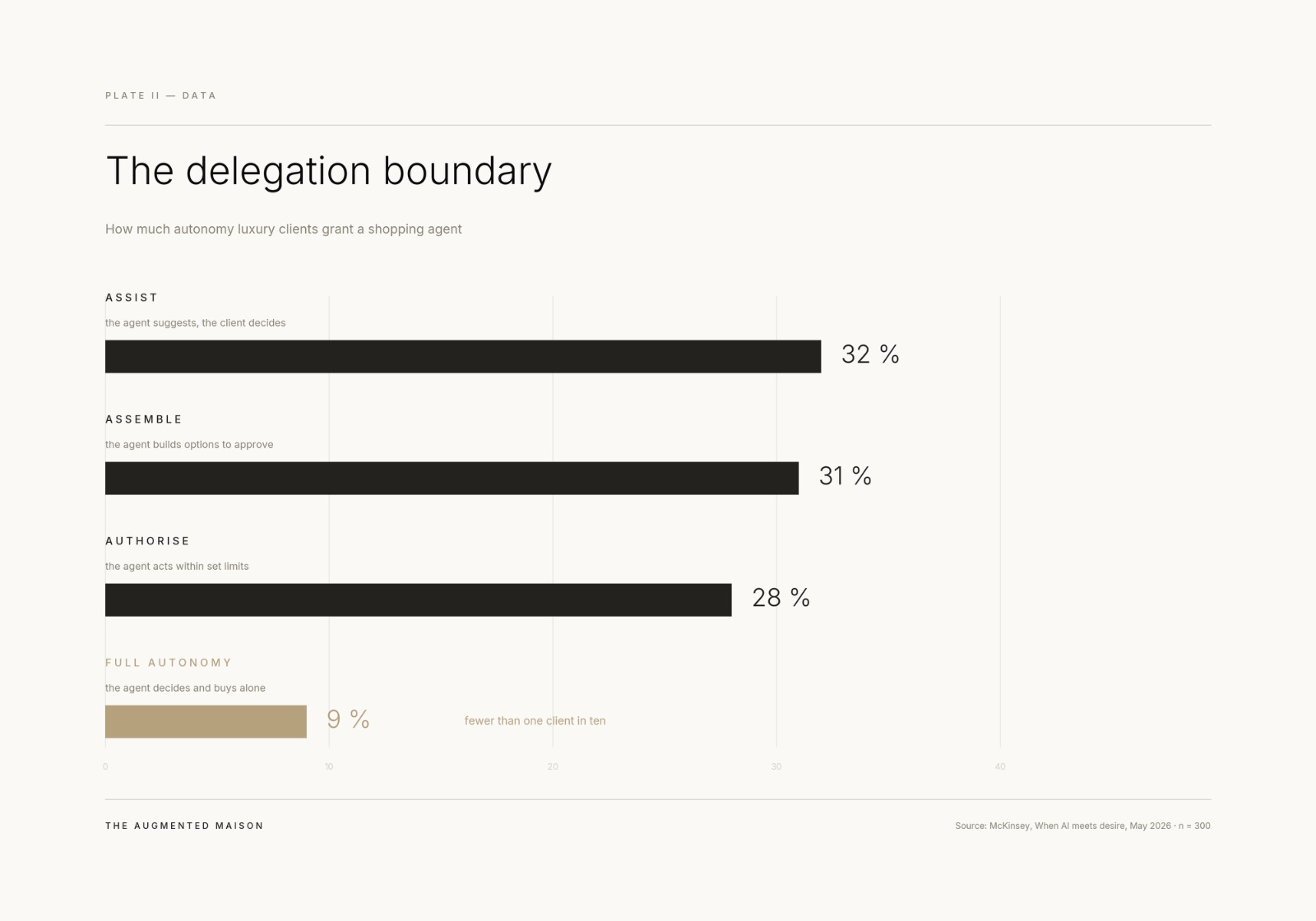
These figures give the role its concrete content. Since March, the agent no longer takes payment and it chooses which products it puts in front of the client. A Maison therefore has to decide which requests it handles alone, such as checking whether a model is in stock at a boutique, and which it passes to an advisor, such as guiding a loyal client towards a gift.
Without those rules, a general-purpose assistant will decide in the Maison's place, using the criteria it applies everywhere else, price and stock on hand.
What those assistants say about a Maison today is the remaining unknown. Without measurement, it surfaces the day a client repeats a recommendation that is wrong or out of date. I built AUGMA for that reason, and OpenAI's retreat makes the question more pressing than it was in February.
What I would tell a Comex this autumn
In February I argued for creating a role.
Today I would recommend four decisions, in this order.
1. Verify Article 50 compliance, binding since 2 August, across every conversational touchpoint the Maison operates.
2. Inventory the agents already active under the brand, internal and third-party, since more than half run without any supervision.
3. Codify brand judgment into machine-readable rules, the condition McKinsey sets for holding on to singularity once agents sit between the brand and the client.
4. Name a single owner for this territory.
The title can be argued later. In the meantime, a client can walk into a boutique with an AI recommendation nobody at the Maison wrote, and nobody on the Comex is currently responsible for answering it.
Sources
McKinsey, « When AI meets desire », 29 mai 2026
IBM Institute for Business Value x Oxford Economics, étude CEO 2026
CNBC, « OpenAI revamps shopping experience in ChatGPT », 24 mars 2026
Modern Retail, « What went wrong with ChatGPT's Instant Checkout », 27 mars 2026
Forrester, « What it means that the leader in agentic commerce just pulled back », 12 mars 2026
Commission européenne, obligations de transparence article 50
Morgan Lewis, « EU AI Act's transparency rules: what went into effect on 2 August », août 2026
Faegre Drinker, « Commission confirms transparency Code of Practice as adequate », juillet 2026